



Finding a mobile app development company isn’t difficult.
Finding the right one is.
A quick search will give you hundreds of agencies, each claiming to build high-quality apps, deliver projects on time, and offer the best value for your investment. On paper, many of them look similar. The real differences only become apparent once the project begins.
The demand for mobile applications continues to grow across industries. According to Grand View Research, the global mobile application market was valued at USD 252.89 billion in 2023 and is projected to reach USD 626.39 billion by 2030, growing at a CAGR of 14.3%. As businesses invest more in mobile-first experiences, choosing the right development partner has become more important than ever.
That’s why selecting a development partner shouldn’t be based solely on price or an impressive portfolio. It requires a clear understanding of your business goals and a careful evaluation of the team’s technical expertise, communication process, and ability to support your product as it evolves.
In this guide, we’ll explain how to choose a mobile app development company, the factors that truly matter during the selection process, and how to identify a long-term mobile development partner that can help turn your idea into a successful digital product.
Why Your Choice of Development Partner Matters
Launching a mobile app is a significant investment, whether you’re building a startup MVP, a customer-facing application, or an enterprise solution. The success of that investment often depends on the team responsible for bringing your idea to life.
A reliable development partner does more than write code. They help validate your product idea, recommend the right technology stack, identify potential risks early, and build an application that can scale as your business grows. Their experience can prevent costly mistakes that are difficult to fix after launch.
The opposite is equally true.
Choosing a company based only on the lowest quote or the fastest delivery promise can lead to missed deadlines, technical debt, inconsistent code quality, and expensive rework. In many cases, businesses end up spending more fixing a poorly built application than they would have by choosing the right partner from the beginning.
The best mobile app development company is one that understands your business objectives, communicates transparently, and works as an extension of your team rather than simply delivering a project.
Define Your Business Goals Before Searching for a Development Company
Before you start comparing agencies or requesting proposals, take a step back and define what you want your mobile application to achieve.
Many businesses begin evaluating development companies before they have a clear product vision. As a result, they receive inconsistent estimates, conflicting technical recommendations, and proposals that are difficult to compare.
Before approaching an app development company, define the following aspects of your project:
- Target audience: Understand who will use the application and what problems it should solve for them.
- Business objectives: Clearly identify whether the app is intended to generate revenue, improve customer engagement, streamline operations, or support another strategic goal.
- Platform requirements: Decide whether you need an Android app, an iOS app, or a cross-platform solution based on your audience, budget, and business priorities.
- Core features: Separate essential features required for the initial launch from enhancements that can be added in future releases.
- Budget and timeline: Establish realistic expectations for development costs, project milestones, and your preferred launch schedule.
It’s also worth understanding the different mobile app development platforms available today. Your technology choice will influence development cost, timeline, performance, and future scalability, making it easier to have productive discussions with potential development partners.
When your business goals are clearly defined, it becomes much easier to evaluate whether a company’s mobile app development services align with your project requirements rather than relying solely on marketing claims or pricing.
12 Factors to Consider When Choosing a Mobile App Development Company
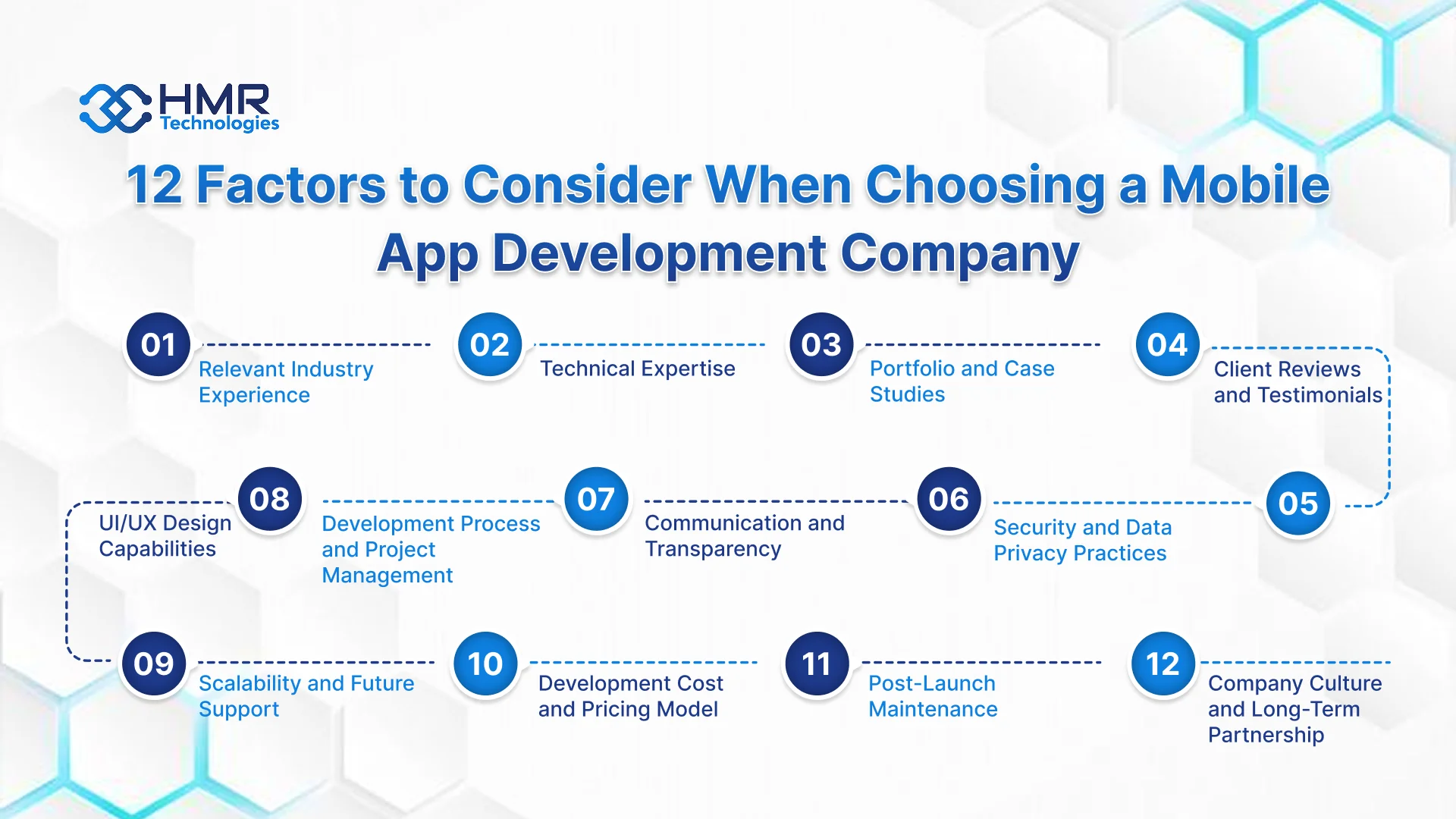
Every mobile app development company will tell you they have the right skills, experienced app developers, and a proven process. The challenge is identifying which partner can actually deliver on those promises.
Instead of making your decision based on pricing or marketing claims alone, evaluate companies across the following factors.
1. Relevant Industry Experience
Industry experience matters because every business domain comes with its own challenges. Building a healthcare application is very different from developing an eCommerce marketplace or a fintech platform.
A company that has worked on projects similar to yours is more likely to understand user expectations, compliance requirements, common integrations, and potential technical challenges. That experience often translates into better recommendations and fewer surprises during development.
2. Technical Expertise
Your development partner should recommend technologies based on your business requirements—not what’s most convenient for their team.
For example, some projects are better suited to cross-platform development because it reduces development time and cost, while others benefit from native development when performance or platform-specific functionality is a priority.
Rather than recommending a single framework for every project, a reliable mobile app development company should explain the advantages and trade-offs of different technologies. Whether it’s Flutter app development, native Android, or another approach, the recommendation should align with your product goals, budget, scalability requirements, and long-term vision.
The best technology choice isn’t necessarily the newest one—it’s the one that helps your business build a reliable, scalable application while meeting both current and future needs.
3. Portfolio and Case Studies
A portfolio should tell you more than what a company has built—it should show how they solve real business problems.
When reviewing previous projects, look for applications that are similar to yours in terms of industry, complexity, or business model. Pay attention to the overall user experience, design quality, feature set, and the application’s ability to address the client’s objectives.
Don’t stop at screenshots alone. Well-documented case studies provide much deeper insights by explaining the client’s challenge, the development approach, the technologies used, and the business results achieved. They also demonstrate whether the company can deliver measurable outcomes rather than simply complete development tasks.
A strong portfolio backed by detailed case studies is often a better indicator of a company’s expertise than the number of projects it has delivered.
4. Client Reviews and Testimonials
Reviews provide valuable insights into what it’s actually like to work with a real client experience.
Instead of looking only at overall ratings, take the time to read detailed client feedback. Pay attention to comments about communication, project management, technical expertise, responsiveness, and post-launch support. These factors often reveal far more than a five-star rating.
- Client references and detailed case studies that showcase real project outcomes.
- Independent review platforms like Clutch to read verified client feedback and ratings.
Finally, don’t base your decision solely on testimonials featured on the company’s website. Take time to explore independent review platforms and verify client experiences from multiple sources. Consistent, authentic feedback across different platforms is usually a much stronger sign of a reliable development partner than a handful of glowing testimonials.
5. UI/UX Design Capabilities
An application can have excellent functionality, but if it’s difficult to use, users are unlikely to keep using it.
Evaluate whether the company follows a structured design process that includes user research, wireframing, prototyping, and usability testing. Strong UI/UX design improves user engagement and often reduces development revisions later in the project.
6. Development Process and Project Management
A structured development process helps projects stay organized and predictable.
Ask how the company manages planning, sprint execution, testing, and deployment. Teams that follow Agile methodologies and provide regular progress updates generally make collaboration easier and reduce project risks.
7. Data Flow, Integrations, and Reliability
A mobile app rarely works in isolation. It often needs to integrate with payment gateways, CRM systems, analytics platforms, cloud services, internal tools, and other third-party applications.
Ask how the development company plans data flow between different systems, manages API integrations, and ensures the application remains reliable as user demand grows. A well-designed architecture improves performance, minimizes integration challenges, and makes it easier to scale your application as your business evolves.
8. Communication and Transparency
Even the most technically skilled team can struggle to deliver a successful project without clear communication.
Choose a development partner that follows a transparent communication process with regular progress updates, scheduled meetings, and clearly defined deliverables. You should always know what has been completed, what the team is currently working on, what is pending, and what the next milestones are.
It’s also worth asking how the team shares project updates, whether through weekly reports, sprint reviews, project management tools, or regular calls. A company that communicates openly and proactively is far more likely to keep your project on track and avoid unnecessary surprises.
9. Security and Data Privacy Practices
Security should be part of the development process from day one—not something that’s addressed after the application is built.
Ask how the company protects sensitive user and business data throughout development. A reliable development partner should follow secure coding practices, implement strong authentication and authorization mechanisms, encrypt sensitive data, and comply with relevant data privacy regulations where applicable.
It’s also worth discussing how they conduct security testing, manage vulnerabilities, and handle third-party integrations. A proactive approach to security helps reduce risks, build user trust, and protect your application as it grows.
10. Development Cost and Pricing Model
Price should be one of several factors—not the deciding factor.
A lower quote may exclude important services such as testing, maintenance, security, or post-launch support. Instead of comparing hourly rates alone, evaluate the overall value the company provides and whether its pricing model aligns with your project goals.
If you’re considering cross-platform development, understanding factors that influence React Native app development cost can also help you evaluate proposals more effectively.
11. Post-Launch Maintenance
Launching your app isn’t the finish line—it’s the beginning of its lifecycle.
After release, your application will need regular updates, bug fixes, performance improvements, security patches, and compatibility updates as new Android and iOS versions are released. User feedback may also lead to new features and enhancements over time.
Before choosing a development partner, understand what their post-launch support includes. Ask about maintenance plans, response times, monitoring, issue resolution, and how they handle future feature development. A company that offers reliable long-term support can help keep your application secure, stable, and ready to grow with your business.
12. Company Culture and Long-Term Partnership
A mobile app is rarely a one-time project. As your business grows, you’ll likely introduce new features, integrate additional services, and continuously improve the user experience.
That’s why it’s important to choose a company that sees itself as a long-term technology partner rather than just a development vendor. Look for a team that values collaboration, understands your business goals, and is willing to provide strategic recommendations throughout the product lifecycle.
A strong cultural fit also makes a difference. Shared expectations, transparent communication, and a collaborative working style can lead to smoother project execution and a more productive partnership. When your development partner is invested in your long-term success, they’re more likely to help your application evolve alongside your business.
Technical Validation Criteria for Mobile App Development
A polished portfolio and positive client reviews are important, but they don’t always reflect the technical quality of a development team. Before making your final decision, validate how the company approaches software architecture, development standards, testing, and long-term maintenance.
Here are a few technical areas worth evaluating:
Code Quality and Architecture
A well-structured codebase is easier to maintain, scale, and enhance over time. Ask whether the team follows coding standards, code reviews, and architecture best practices to ensure long-term stability.
Technology Stack Selection
A reliable development company should recommend technologies based on your business requirements—not personal preference. They should clearly explain why a particular Android app frameworks, programming language, or development approach is the right fit for your project.
API Integrations and Data Flow
Most mobile applications rely on third-party services such as payment gateways, CRMs, analytics tools, and cloud platforms. Ask how the team manages API integrations, data flow, and system reliability to ensure smooth communication between different services.
Testing and Quality Assurance
Testing should be part of the development lifecycle, not something that’s done just before launch. Understand their approach to functional testing, performance testing, security testing, device compatibility, and bug tracking.
Performance and Scalability
Your application should be able to handle increasing users and data without affecting performance. Ask how the company optimizes app performance, manages scalability, and prepares the application for future growth.
DevOps and Deployment Process
Understanding how the team handles version control, CI/CD pipelines, deployment, and release management can give you confidence that updates will be delivered efficiently and with minimal disruption.
Evaluating these technical capabilities helps you choose a mobile app development company that can build a secure, scalable, and future-ready application—not just deliver a working product.
Questions to Ask Before Hiring a Mobile App Development Company
The right questions can tell you far more than a sales presentation ever will. They help you understand how a company works, how transparent it is, and whether it’s the right long-term partner for your project.
What similar apps have you built?
Ask for examples that closely match your industry or business model. A company with relevant experience can often identify potential challenges early and recommend practical solutions based on previous projects.
Who owns the source code?
Source code ownership should always be discussed before development begins. Make sure your agreement clearly states that you retain ownership of the application, codebase, documentation, and other project assets after completion.
How do you handle communication?
Every development company has its own communication process. Ask how often you’ll receive project updates, which collaboration tools they use, and who your primary point of contact will be throughout the project.
What happens after launch?
Launching an app is only the beginning. Ask whether the company provides post-launch maintenance, bug fixes, performance monitoring, operating system updates, and ongoing feature enhancements.
What is your testing process?
Quality assurance should be part of the development lifecycle, not an afterthought. Ask about manual testing, automated testing, device compatibility testing, security testing, and performance validation before release.
How do you estimate project timelines?
Reliable companies don’t promise unrealistic deadlines. Instead, they break projects into milestones, explain dependencies, and provide realistic delivery schedules based on project complexity.
In-House Team vs Outsourcing vs Dedicated Development Team
There isn’t a single development model that’s right for every business. The best approach depends on your budget, project complexity, internal resources, and long-term product strategy.
| Factor | In-House Team | Outsourcing | Dedicated Development Team |
|---|---|---|---|
| Initial Cost | High | Low to Moderate | Moderate |
| Hiring Time | Long | Very Short | Short |
| Scalability | Limited by hiring | Depends on vendor | Highly scalable |
| Project Control | Complete | Moderate | High |
| Technical Expertise | Depends on internal team | Varies by provider | Access to specialized experts |
| Long-Term Support | Internal responsibility | Contract-based | Continuous collaboration |
| Best For | Large organizations with ongoing development | Short-term projects | Growing startups and businesses building long-term products |
An in-house team offers maximum control but requires significant investment in hiring, training, and infrastructure. Outsourcing is often suitable for smaller or one-time projects where speed and budget are the primary considerations.
A dedicated development team offers a balanced approach. Businesses gain access to experienced developers, designers, QA engineers, and project managers who work as an extension of their internal team. This model provides greater flexibility, easier scaling, and long-term collaboration without the overhead of building an in-house department from scratch.
Why Businesses Choose HMR Technologies as Their Mobile Development Partner
Choosing a mobile app development company is about more than technical expertise. Businesses need a partner who understands their goals, communicates transparently, and can support their product beyond the initial launch.
At HMR Technologies, we combine technical excellence with a business-first approach to help startups, growing companies, and enterprises build scalable mobile applications. Our team works closely with clients from product discovery and UI/UX design to development, testing, deployment, and post-launch support.
Whether you’re planning a native Android or iOS application or exploring cross-platform solutions, our mobile app development services are tailored to your business requirements rather than a one-size-fits-all development approach. We also help businesses evaluate technologies such as Flutter and React Native to ensure the chosen solution aligns with their budget, timeline, and long-term product strategy.
As a long-term mobile development partner, our focus extends beyond delivering an application. We help businesses improve performance, introduce new features, and scale their products as user needs evolve.
Conclusion
Choosing the right mobile app development company isn’t about finding the lowest price or the largest portfolio. It’s about selecting a partner that understands your business, recommends the right technologies, and has the expertise to build a reliable, scalable application.
By evaluating factors such as industry experience, technical capabilities, communication practices, security standards, and post-launch support, you’ll be in a much stronger position to make an informed decision. Taking the time to ask the right questions before development begins can also help prevent costly mistakes later in the project.
If you’re still exploring your options, reviewing this mobile app development guide for businesses can provide additional insights into planning, developing, and scaling a successful mobile application.
Ultimately, the best mobile app development company is one that works as an extension of your team, helping you build a product that delivers long-term value for both your business and your users.

-for-enterprise-AI-integration.webp)
 June 30, 2026
 10 min read