




You have a mobile app idea. You have done the research, validated the concept, and now you are staring at a blank spreadsheet trying to answer the one question every founder dreads: how much is this actually going to cost?
But cost isn’t a number; it’s a function of decisions. Scope, development team, timeline, and technology choices each pull the final invoice in a different direction.
React Native has become the go-to framework for cross-platform mobile development, and for good reason. It powers apps used by millions — Facebook, Shopify, Bloomberg, and Tesla have all built on it.
It lets you build for both iOS and Android from a single codebase, which immediately cuts development time and budget compared to building two native apps separately. But “more affordable than native” doesn’t mean cheap, and misunderstanding what drives the react native app development cost is how projects go over budget.
This article breaks down exactly what you’re paying for when you build a React Native app in 2026, from the factors that push costs up, to the development stage breakdown, to how team location affects your budget, to practical strategies for keeping spend under control without killing quality. Whether you’re evaluating this for the first time or pressure-testing a quote you’ve already received, this guide gives you the framework to make a confident decision.
What Is React Native App Development?
React Native is an open-source framework built by Meta that allows developers to write a single JavaScript codebase and deploy it as both an iOS and Android app. Unlike hybrid web apps wrapped in a browser shell, React Native renders actual native components — which means the performance and feel is close to apps built entirely in Swift or Kotlin.
For businesses, this has one major practical implication: you’re not paying for two separate development teams. The same codebase — with some platform-specific adjustments — powers both platforms. That alone can reduce development time by 30–40% compared to fully native builds.
React Native is production-proven at scale. Apps like Facebook, Instagram, Shopify, and Walmart have used it in various capacities. It has a massive developer ecosystem, strong community support, and integrates cleanly with most third-party APIs and backend systems.
From enterprise-grade solutions to on-demand services and eCommerce apps, React Native serves the full spectrum — enterprises, SMEs, and startups alike can build production-ready mobile products without the overhead of maintaining two separate native codebases.
React Native sits at a practical sweet spot: better performance than pure hybrid approaches, lower cost than dual native development, and a large talent pool that keeps hourly rates competitive.
How Much Does React Native App Development Cost in 2026?
Before getting into the variables, here’s a grounded reference range based on current market data for React Native apps.
| App Complexity | Estimated Cost | Timeline |
|---|---|---|
| Simple / MVP | $8,000 – $20,000 | 2–4 months |
| Mid-Complexity | $25,000 – $70,000 | 4–7 months |
| Complex / Enterprise | $75,000 – $250,000+ | 8–14+ months |
These figures reflect end-to-end development — design, development, testing, deployment, and a basic post-launch support window. They are not “app factory” quotes for templated builds; they represent properly scoped, custom mobile products.
Simple App/ MVP: A simple app typically includes basic authentication, 3–5 core screens, a lightweight backend, and no third-party integrations beyond maybe a payment gateway. Think: a booking app for a local service business or an internal tool for a small team.
Mid-Complexity: A mid-complexity app introduces real-time features, custom UI, CMS integration, and moderate backend logic — the kind of product a funded startup would take to market.
Complex / Enterprise: A complex or enterprise app brings in role-based access control, compliance layers (HIPAA, PCI-DSS, GDPR), AI-driven features, high-load infrastructure, and advanced analytics. This is where you’re building a platform, not just an app.
Why Invest in React Native for Your Business?
Before dissecting costs, it’s worth understanding why React Native justifies the investment — because the math only works if the framework is the right fit.
Building separate native iOS and Android apps typically means two development teams, two codebases, two QA cycles, and two ongoing maintenance streams. React Native collapses that into one. For a mid-complexity product, that can represent a 30–40% reduction in initial build cost and ongoing savings of a similar magnitude on every future update.
Time-to-market is the other lever. In competitive markets, fintech, e-commerce, and on-demand services shipping six weeks faster than a competitor isn’t a minor advantage. React Native’s shared codebase means a single team can deploy to both platforms simultaneously rather than sequentially.
The talent pool is another practical consideration. React Native developers are JavaScript/React developers with mobile specialization, a far larger pool than platform-specific Swift or Kotlin developers. A larger supply means more hiring flexibility and generally more competitive rates.
There’s also a maturity argument. React Native is no longer an early-stage framework with rough edges. It’s battle-tested at scale, with Meta, Microsoft, and Shopify all actively contributing to its development. The architectural improvements from the “New Architecture” overhaul, Fabric renderer, TurboModules, and JSI have addressed longstanding performance concerns, making React Native a credible choice even for performance-intensive applications.
Key Factors That Influence React Native App Development Cost
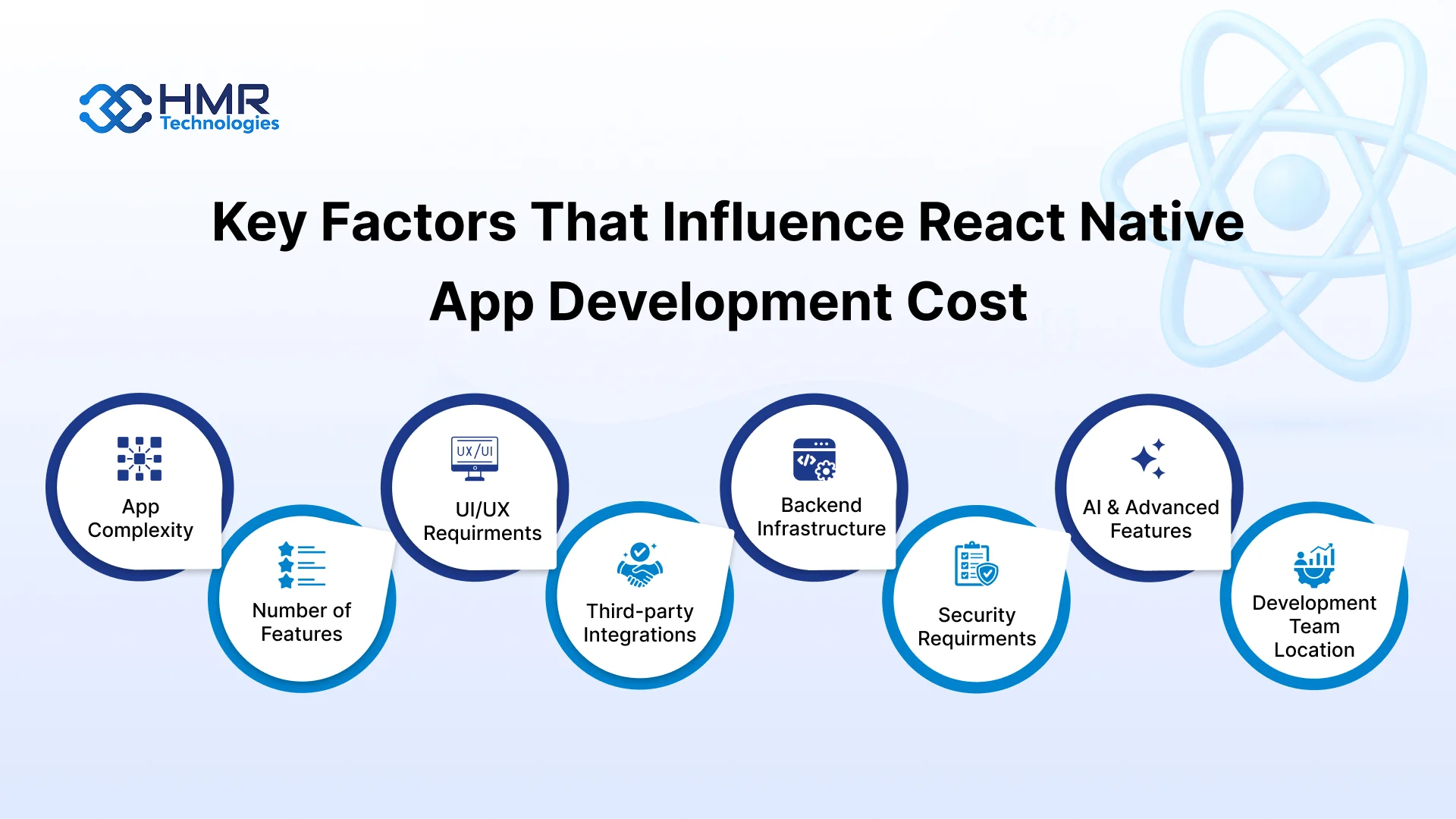
Every React Native app has unique needs, and multiple factors shape its development cost, team structure, and timeline. Elements like feature complexity, design requirements, integrations, security, and team expertise all influence the final budget, making each project’s pricing distinct.
App Complexity
Complexity isn’t just about features; it’s about the logic behind them. A simple app with static content, a login screen, and basic navigation sits at the low end. An app with real-time data sync, live chat, custom algorithms, or multi-tenant architecture is exponentially more complex to build and test.
Number of Features
Features aren’t additive—they’re multiplicative in their impact on cost. Each new feature requires design, development, integration testing, edge-case handling, and documentation. A payment gateway integration, for example, typically adds $5,000–$15,000 to a project budget when you account for the full implementation cycle, not just the API connection. The assumption that you’re adding “just one more feature” is one of the primary causes of budget overruns.
UI/UX Requirements
Standard UI with off-the-shelf components is affordable. Custom design with bespoke animations, brand-specific interactions, and accessibility compliance takes significantly more time. Expect UI/UX to account for 15–20% of total project cost on a standard build, rising to 25–30% for design-heavy applications. Complex UI is often where mid-complexity apps drift into higher budget tiers.
Third-Party Integrations
Every external service Stripe, Twilio, Google Maps, analytics platforms, and CRMs, adds integration work, error handling, and ongoing maintenance. Budget roughly 20–40 hours per major integration, depending on API quality and documentation available.
Backend Infrastructure
Mobile apps don’t exist in isolation. The backend — APIs, databases, authentication systems, cloud infrastructure — often costs as much as the app itself. A simple Node.js backend on managed cloud infrastructure is one end of the spectrum; a microservices architecture with real-time data sync and horizontal scaling is another.
Security Requirements
Healthcare and fintech apps carry compliance obligations — HIPAA, PCI-DSS, GDPR — that impose significant development overhead. Security audits, encrypted storage, secure authentication flows, and compliance documentation add $10,000–$30,000 to projects in regulated industries.
AI and Advanced Features
ML-powered recommendations, computer vision, NLP, predictive analytics — these capabilities are increasingly expected but add meaningful cost. AI feature implementation typically starts at $15,000 and scales with complexity and model training requirements.
Development Team Location
More on this in its own section, but team geography can swing your budget by 200–300%. A US-based senior developer bills at $120–$180/hr. An equally skilled developer in Eastern Europe or South Asia might bill at $25–$60/hr.
React Native App Development Cost Breakdown by Project Stage
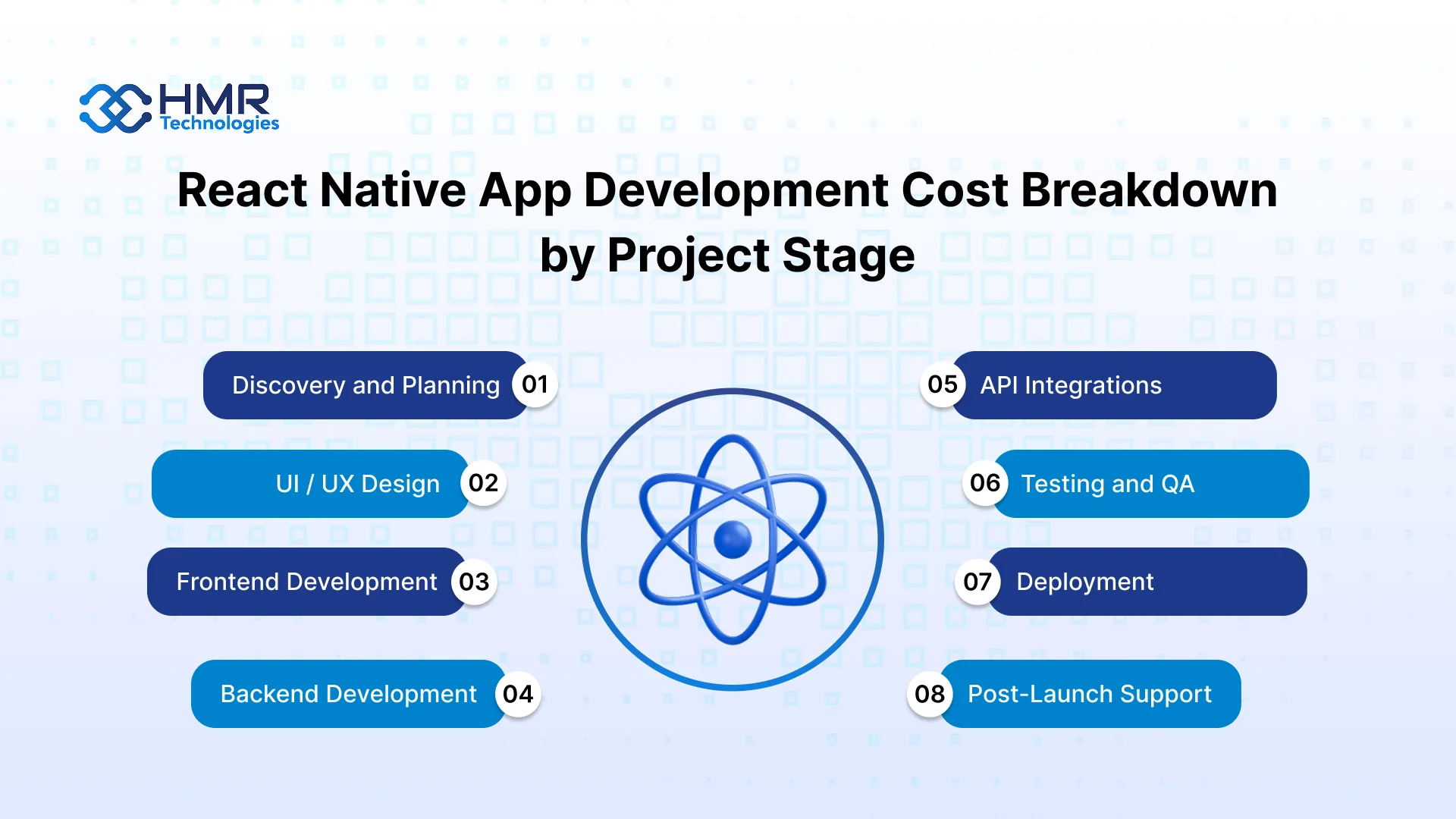
Understanding cost by stage helps you allocate budget intelligently and identify where to invest versus where to economize.
Discovery and Planning
Typical cost: $2,000 – $8,000
This phase includes requirement gathering, competitor analysis, technical architecture, and project scoping. Skipping it is a false economy — projects without solid discovery tend to cost 30–50% more due to mid-project pivots.
UI/UX Design
Typical cost: $4,000 – $20,000
Wireframes, user flows, and high-fidelity prototypes. For consumer apps in competitive markets, design is a growth lever, not just an aesthetic choice. Investing here reduces user drop-off and improves conversion.
Frontend Development
Typical cost: $10,000 – $60,000
The React Native codebase itself — screens, navigation, state management, component architecture. This is where your app’s user experience actually gets built.
Backend Development
Typical cost: $8,000 – $50,000
APIs, database design, business logic, server infrastructure. Complex apps with real-time features, complex queries, or high-volume traffic require more robust backend architecture.
API Integrations
Typical cost: $2,000 – $15,000
Third-party service connections — payment gateways, analytics, CRMs, communication tools. Cost scales with the number of integrations and the complexity of each.
Testing and QA
Typical cost: $3,000 – $20,000
Manual testing, automated test suites, performance testing, and device compatibility checks. Budget 15–20% of the total development cost for thorough QA.
Deployment
Typical cost: $1,000 – $5,000
App Store and Google Play submissions, production environment configuration, CI/CD pipeline setup. Often underestimated by first-time builders.
Post-Launch Support
Typical cost: $1,500 – $8,000/month
Bug fixes, OS version updates, feature iterations, and performance monitoring. Allocate this from day one — an unmaintained app degrades as fast as iOS and Android release updates.
React Native App Cost Based on Application Type

Mobile app development cost varies significantly by vertical. Here’s what realistic budgets look like for common app categories:
E-commerce Apps — $30,000–$120,000
Product catalog, cart, checkout, payment gateway, order tracking, push notifications, and admin dashboard. Costs rise sharply with catalog size, multi-currency support, and personalization features.
Healthcare Apps — $60,000–$250,000+
HIPAA compliance, EHR integration, telemedicine features, prescription management, and audit logging make healthcare among the most expensive categories. Security architecture alone can represent 20–30% of total budget.
FinTech Apps — $70,000–$300,000+
KYC/AML compliance, bank integrations via Plaid or open banking APIs, fraud detection, real-time transaction processing, and multi-currency support. Regulatory requirements make FinTech cost-intensive regardless of feature count.
Social Networking Apps — $40,000–$150,000
Real-time feeds, media upload/playback, user-generated content moderation, notifications, and social graph management. Scalability infrastructure is the primary cost driver as user bases grow.
On-Demand Service Apps — $50,000–$180,000
Real-time location tracking, dynamic pricing, provider/consumer matching, in-app communication, and payment processing. Think Uber or DoorDash architecture — the backend complexity is significant.
SaaS Mobile Applications — $40,000–$200,000
Multi-tenant architecture, subscription billing, role-based access control, analytics dashboards, and API-first design for third-party integrations.
How Does Team Structure and Location Impact Development Costs?
Choosing the right app development team plays a critical role in determining overall project costs and success, as experienced teams ensure efficient execution, fewer errors, and better long-term scalability.
This is one of the most consequential decisions you’ll make. Hourly rates vary dramatically by geography:
| Region | Average Hourly Rate |
|---|---|
| North America (US/Canada) | $100–$200/hr |
| Western Europe (UK, Germany) | $75–$150/hr |
| Eastern Europe | $40–$80/hr |
| South Asia (India, Pakistan) | $20–$50/hr |
| Southeast Asia | $25–$60/hr |
A typical React Native project may involve:
- Project Manager
- Business Analyst
- UI/UX Designer
- React Native Developers
- Backend Developers
- QA Engineers
- DevOps Specialists
Hiring an in-house team provides control but increases overhead costs related to recruitment, salaries, infrastructure, and management.
Freelancers may reduce short-term costs but can introduce coordination and scalability challenges.
Dedicated development teams offer a balanced approach by providing specialized expertise, structured workflows, and predictable pricing.
Development location also matters. Companies in the USA, UK, and Canada frequently partner with experienced offshore teams to access high-quality development at lower costs.
How to Reduce React Native App Development Costs Without Compromising Quality
Cost reduction in software development isn’t about spending less — it’s about spending more precisely.
Build an MVP first
Launch with the smallest feature set that delivers real value to real users. A focused MVP development typically costs 40–60% less than a full-featured v1, and it generates the user feedback that should be driving your roadmap anyway. Most features you think you need at launch turn out to be wrong guesses.
Prioritize core features ruthlessly
Every feature that doesn’t directly support your core value proposition is a cost with uncertain return. Defer social sharing, gamification, advanced analytics, and “nice-to-have” integrations to post-launch iterations.
Use reusable component libraries
React Native’s ecosystem includes mature UI libraries like React Native Paper, NativeBase, and Tamagui. Leveraging these instead of building custom components from scratch can reduce frontend development time by 20–35%.
Choose experienced developers
Counter-intuitive, but senior developers are frequently more cost-effective than junior developers. They write cleaner code, catch architecture problems early, require less oversight, and produce fewer bugs that become expensive post-launch fixes.
Adopt Agile development
Two-week sprint cycles with working deliverables create natural checkpoints where you can redirect, deprioritize, or stop — rather than discovering scope issues after months of development. Agile isn’t just a methodology; it’s budget control.
Why Choose HMR Technologies for React Native App Development?
HMR Technologies brings 10+ years of mobile and web development experience to every engagement, with a track record across e-commerce, healthcare, SaaS, and on-demand service applications. The team operates as a full-stack development partner, which means clients get strategic input alongside technical execution.
From MVP development to enterprise-grade mobile solutions, we focus on creating applications that deliver measurable business value. Our development process emphasizes transparency, scalability, security, and user experience at every stage.
Whether you need a customer-facing mobile application, a SaaS platform, or an enterprise mobility solution, our React Native specialists can help you build and launch faster while optimizing long-term development costs.
If you’re evaluating a React Native development service, the right conversation starts with your business goals — not a feature list. That’s where HMR Technologies starts too.
Conclusion
The react native app development cost in 2026 ranges from $15,000 for a focused MVP to $300,000+ for a complex, enterprise-grade product — and the difference isn’t arbitrary. It’s driven by features, compliance requirements, team expertise, and how thoughtfully the project is scoped from day one.
The founders who get the most value from their development budget share a few things: they define scope ruthlessly, they choose teams based on demonstrated output rather than hourly rate, and they invest in discovery before they invest in code. React Native gives you a structural cost advantage over native development. How you use that advantage is a strategic decision.
If you’re serious about building a mobile product that performs in the market, the next step is a conversation with a team that can map your requirements to a realistic plan.
If you’re evaluating the cost to build a React Native app and want expert guidance tailored to your business goals, HMR Technologies can help. Our team specializes in delivering scalable, high-quality React Native solutions that balance performance, user experience, and development efficiency. Contact us today to discuss your project and receive a customized development estimate.


 June 22, 2026
 10 min read