



Introduction
Mobile apps are no longer optional for businesses. From early-stage startups to large enterprises, mobile applications have become a core channel to reach users, deliver services, and drive revenue. However, the success of a mobile app depends heavily on one early decision: choosing the right mobile app development platform.
With so many options available today, businesses often struggle to identify the best platform for mobile app development that aligns with their goals, budget, and long-term vision.
A startup may prioritize speed and cost efficiency, while an enterprise may focus on performance, security, and scalability.
This blog explores the most reliable mobile app development platforms, explains how they fit into the mobile app development process, and helps startups and enterprises make informed decisions.
What Are Mobile App Development Platforms?
Mobile app development platforms are technologies, frameworks, or environments used to design, build, test, and deploy mobile applications.
These platforms provide developers with tools, libraries, and APIs that simplify the development workflow.
In the mobile app development process, platforms act as the foundation on which apps are built. They influence how fast an app can be developed, how well it performs, and how easily it can scale as the business grows.
Broadly, mobile app development platforms fall into three categories: native platforms, cross-platform frameworks, and no-code or low-code platforms. Each serves a different purpose and business requirement.
For businesses focused on long-term growth, selecting the right platform is not just a technical decision; it’s a strategic one.
Best Mobile App Development Platforms for Startups and Enterprises
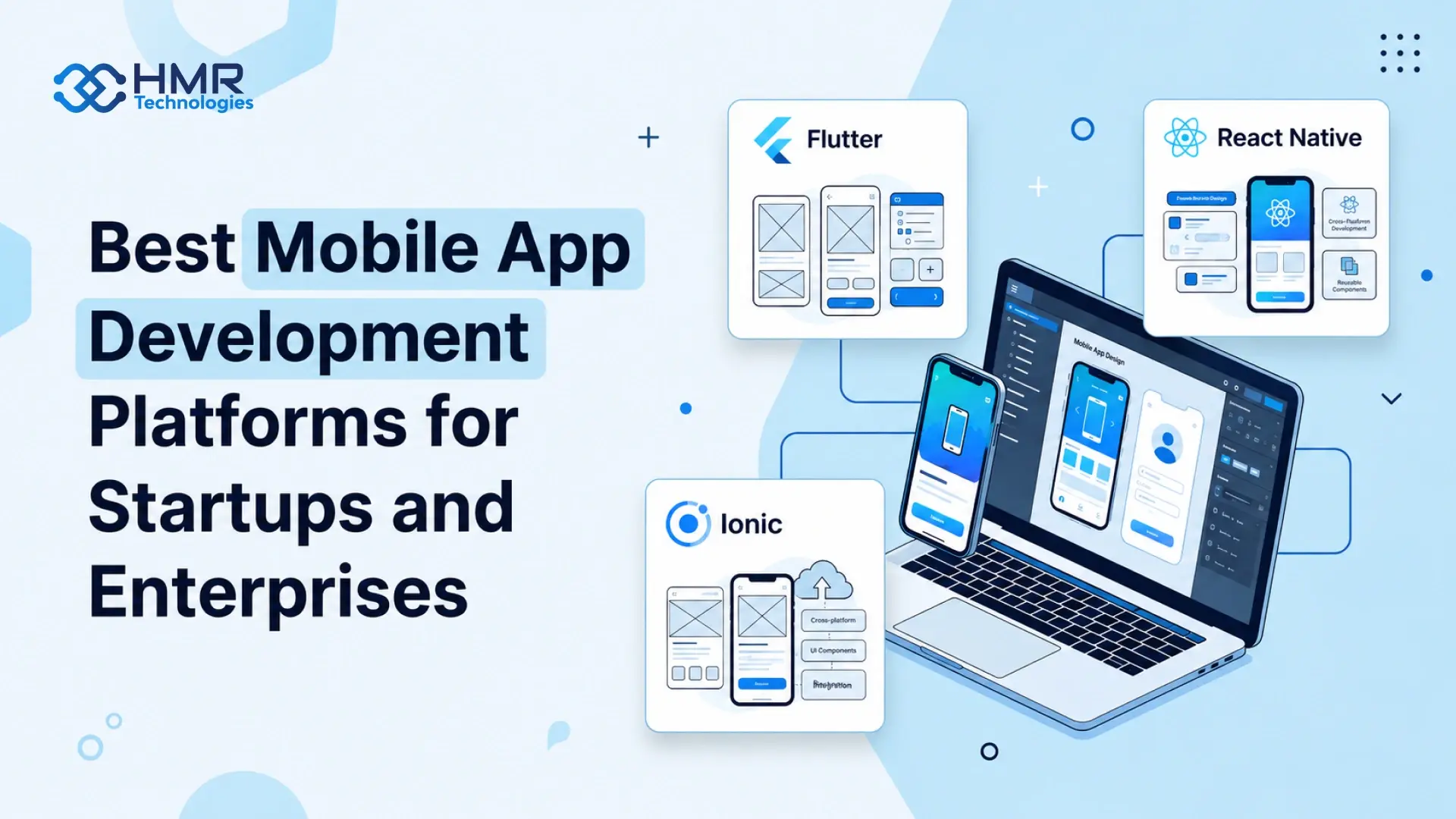
Choosing the right mobile app development platform plays a major role in how smoothly your product moves through the mobile app development process. Each platform comes with its own strengths and trade-offs, making some better suited for startups and others more reliable for enterprise-scale applications.
Below is a practical breakdown of the most widely used mobile app development platforms, along with their benefits and limitations.
Flutter
Flutter is a cross-platform mobile app development platform by Google that allows businesses to build Android and iOS apps using a single codebase. It is widely used by startups and enterprises for creating fast, visually rich, and modern mobile applications.
This makes Flutter a strong option for businesses focused on modern design and fast development cycles, making Flutter App Development a popular choice for startups and enterprises looking to launch applications faster.
Benefits of Flutter app development
- Faster development with a single codebase for multiple platforms
- Smooth UI and consistent performance across devices
- Strong support for modern, custom app designs
Limitations of Flutter app development
- App size can be larger compared to native apps
- Platform-specific features may need extra customization
- Complex enterprise apps require careful architecture planning
React Native
React Native is a popular cross-platform mobile app development platform developed by Meta. It allows developers to build Android and iOS applications using JavaScript and a shared codebase, making it a practical choice for startups and growing businesses.
Many companies choose React Native App Development to accelerate time-to-market while maintaining a consistent experience across both platforms.
Benefits of React Native app development
- Faster development with reusable code across platforms
- Large community support and rich library ecosystem
- Easy integration with existing web and JavaScript projects
Limitations of React Native app development
- Performance may drop for graphics-heavy or complex apps
- Debugging can be challenging when native modules are involved
- Requires native code knowledge for advanced features
Ionic
Ionic is a hybrid mobile app development platform that uses web technologies like HTML, CSS, and JavaScript to build cross-platform mobile applications. It is commonly used by startups and businesses looking to turn web apps into mobile apps quickly.
Benefits of Ionic app development
- Cost-effective development using a single codebase
- Easy to use for teams with web development experience
- Supports rapid development and quick deployment
Limitations of Ionic app development
- Performance depends on WebView and may feel slower than native apps
- Limited access to advanced native features
- Not ideal for high-performance or graphics-intensive applications
Xamarin
Xamarin is a cross-platform mobile app development platform backed by Microsoft that allows developers to build Android and iOS apps using C#. It is widely used by enterprises, especially those already working within the .NET ecosystem.
Benefits of app development
- Strong native performance with shared codebase
- Seamless integration with Microsoft and .NET technologies
- Suitable for secure and enterprise-grade applications
Limitations of app development
- Smaller community compared to Flutter and React Native
- Steeper learning curve for teams new to C#
- App size can be larger than other cross-platform frameworks
No-Code/Low-Code App Development Platforms to Create Mobile Apps
No-code and low-code platforms have gained attention as businesses look for faster and more cost-effective ways to launch applications. These platforms allow users to create mobile apps with minimal manual coding by using visual interfaces and pre-built components.
For startups validating ideas or enterprises building internal tools, no-code platforms can significantly shorten the mobile app development process. They are especially useful for simple apps, prototypes, dashboards, and workflow automation.
However, these platforms come with limitations. Customization, performance optimization, and advanced integrations are often restricted. While they are suitable for early-stage use cases, businesses planning complex, customer-facing apps usually outgrow them.
As a result, no-code and low-code platforms are best viewed as complementary solutions rather than replacements for full-scale mobile app development platforms.
How to Choose the Right Platform: Startup vs Enterprise Checklist
Choosing the best platform for mobile app development depends on business size, goals, and technical requirements.
Startup Checklist
- Faster time-to-market with limited resources
- Lower development and maintenance costs
- Ability to iterate quickly based on user feedback
- Support for MVP and future scalability
Enterprise Checklist
- High performance and stability at scale
- Strong security and compliance support
- Seamless integration with existing systems
- Long-term maintainability and vendor support
Using this checklist helps align technical choices with real business needs, ensuring the platform supports growth rather than limiting it.
Why Choosing the Right Platform Matters
The platform you choose directly impacts the success of your mobile app. A poor platform decision can lead to performance issues, higher costs, delayed launches, and scalability problems.
In the mobile app development process, the platform determines development speed, testing complexity, and long-term flexibility. For startups, the wrong choice can exhaust budgets before product-market fit is achieved. For enterprises, it can introduce security risks and operational inefficiencies.
The right platform ensures smoother development cycles, better user experience, and easier future enhancements. It also enables businesses to adapt to market changes without rebuilding applications from scratch.
This is why platform selection should involve both technical and business stakeholders, not just developers.
Conclusion
There is no single best platform for mobile app development that fits every business. Startups benefit from platforms that prioritize speed, flexibility, and cost efficiency, while enterprises require solutions that deliver performance, security, and scalability.
Understanding different mobile app development platforms and how they fit into your business strategy is essential for long-term success. Whether you choose native, cross-platform, or low-code solutions, the key is aligning technology with your business goals.
For companies investing in mobile app development for business, making the right platform choice early can save time, reduce costs, and create a stronger foundation for growth.



 July 13, 2026
 10 min read