




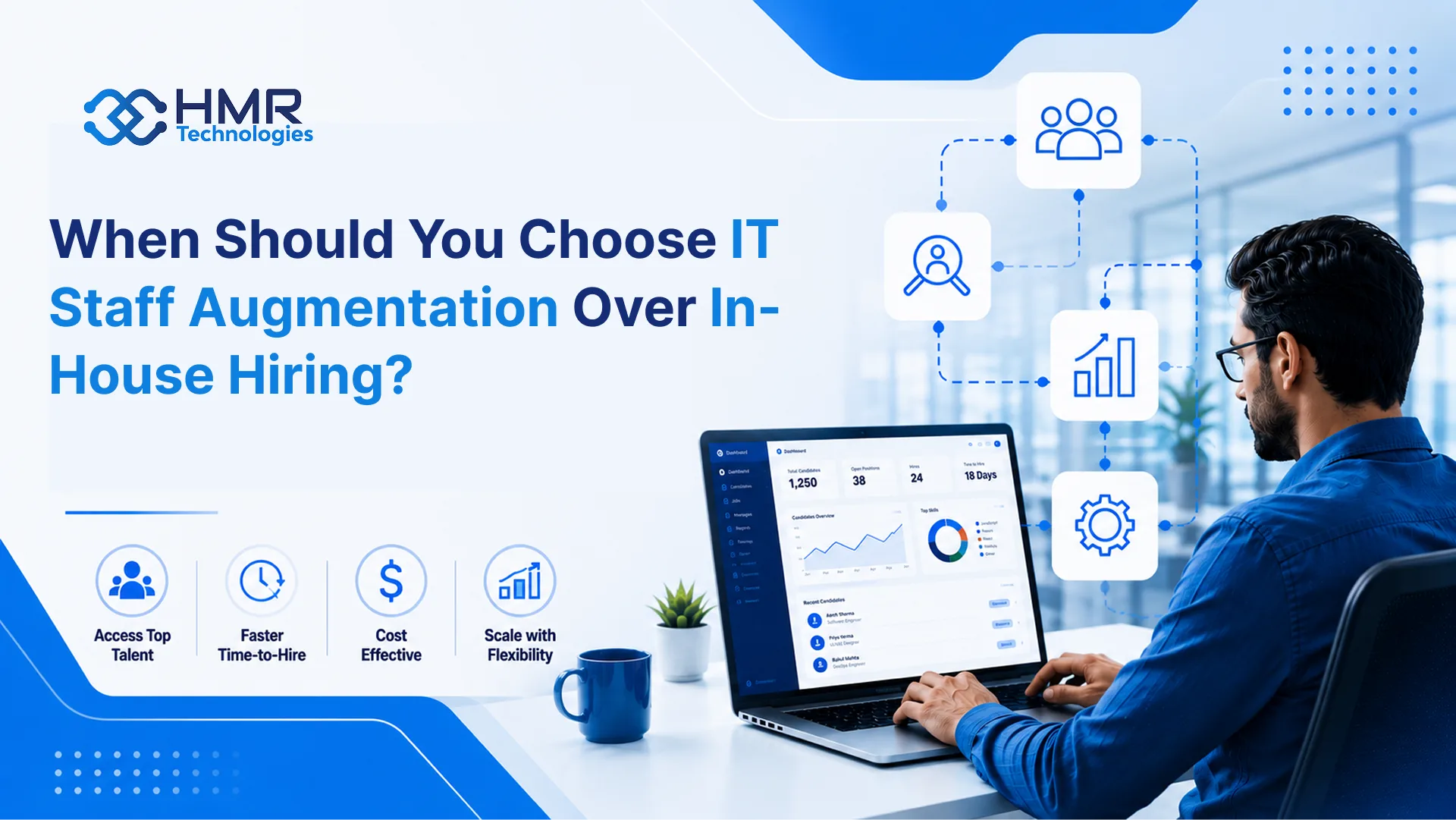
Hiring great developers has never been easy.
Today, it’s even harder.
Businesses are expected to launch products faster, adopt emerging technologies, and scale development teams quickly. At the same time, finding experienced developers has become more competitive, in-house hiring processes are getting longer, and hiring costs continue to rise for hire permanent employees.
That’s why many Business leaders face a decision about how they build their engineering teams.
Instead of waiting months to recruit full-time employees, they’re extending their existing teams with experienced developers who can start contributing almost immediately. This approach, known as IT staff augmentation, gives businesses the flexibility to scale development capacity without the long-term commitments of traditional onsite hiring.
Whether you are building a SaaS product, launching an MVP, modernizing an existing application, or accelerating digital transformation, IT staff augmentation services help you access specialized talent exactly when you need it.
In this guide, we’ll explain what IT staff augmentation is, how it compares with in-house hiring, when it makes the most sense for your business, and how to choose the hiring model that supports your long-term growth.
Understanding IT Staff Augmentation
Imagine you are developing a new product and suddenly need a dedicated development team, such as three experienced backend developers, two frontend developers, a DevOps engineer, QA engineers, and project managers for the upcoming release.
In-house hiring of full-time employees could take weeks or even months. Waiting that long might delay your product launch and affect your business opportunities.
This is where IT staff augmentation becomes a practical solution.
IT staff augmentation is a flexible hiring model that allows businesses to strengthen their existing engineering teams with external technology professionals. Instead of recruiting permanent employees, organizations can quickly onboard experienced developers with the specific skills needed for a project.
Unlike traditional outsourcing, where a third-party vendor manages an entire project, augmented developers work as an extension of your in-house team. They follow your development processes, use your preferred tools, collaborate with your internal stakeholders, and report to your project managers, giving you full visibility and control throughout the development lifecycle.
Businesses commonly use staff augmentation for software development to:
- Fill temporary skill gaps within their engineering team.
- Accelerate product development without expanding permanent headcount.
- Access specialized expertise in emerging technologies.
- Support short-term or high-priority development projects.
- Scale engineering capacity during periods of rapid business growth.
For businesses that need long-term collaboration, combining staff augmentation with a dedicated development team model can provide even greater flexibility while maintaining full control over product development.
Why Businesses Choose IT Staff Augmentation
The way companies build software teams has changed significantly over the last few years. Faster product launches, evolving technologies, and increasing competition have made traditional hiring slower and less practical for many businesses.
Instead of expanding permanent teams for every new project, organizations are adopting IT staff augmentation to access specialized talent exactly when it’s needed. This approach allows them to remain agile while maintaining full control over product development.
Here are some of the key reasons businesses are choosing this hiring model:
- Faster access to skilled developers: Reduce hiring time by bringing experienced professionals into your team when they’re needed most.
- Greater flexibility: Scale your development team up or down based on project requirements without restructuring your organization.
- Access to specialized expertise: Quickly onboard developers with experience in specific technologies, frameworks, or industry domains.
- Lower recruitment overhead: Minimize the time and costs associated with sourcing, interviewing, hiring, and onboarding full-time employees.
- Better project continuity: Fill resource gaps caused by employee turnover, expanding project scope, or aggressive delivery timelines.
Rather than replacing internal teams, IT staffing solutions enable businesses to strengthen existing capabilities and deliver software projects more efficiently while maintaining full visibility and control over the development process.
IT Staff Augmentation vs In-House Hiring: What’s the Difference?
Both IT staff augmentation and in-house hiring can help you build a capable engineering team, but they have different business needs. The right choice depends on factors such as project duration, hiring timelines, budget, required expertise, and long-term growth plans.
If your business needs a permanent team to drive ongoing product development, hiring in-house may be the right approach. However, if you need to quickly fill skill gaps, accelerate development, or scale resources for a specific project, IT staff augmentation often provides greater flexibility and speed.
The comparison below highlights the key differences between the two models.
| Factor | IT Staff Augmentation | In-House Hiring |
|---|---|---|
| Hiring Speed | Developers can be onboarded in days or weeks. | Recruitment and onboarding can take several months. |
| Flexibility | Easily scale the team up or down as project needs change. | Scaling requires additional hiring or restructuring. |
| Access to Talent | Immediate access to specialized technical expertise. | Limited to available candidates in the hiring market. |
| Cost Structure | Pay only for the resources you need during the engagement. | Includes salaries, benefits, infrastructure, training, and recruitment costs. |
| Project Control | Your internal team manages the project and daily activities. | Complete internal ownership and management. |
| Best For | Short-term projects, product scaling, and specialized expertise. | Long-term product development and permanent engineering teams. |
Neither model is universally better. Many organizations combine both approaches—maintaining a core in-house team while using IT staffing solutions to add specialized expertise whenever additional capacity is required.
When Is IT Staff Augmentation the Right Choice for Your Business?
Not every project requires expanding your permanent workforce. In many situations, augmenting your existing team is a faster, more cost-effective way to achieve your business goals.
You should consider IT staff augmentation when:
You Need to Fill Skill Gaps Quickly
Modern software projects often require expertise in technologies that your internal team may not have. Instead of spending months recruiting specialists, staff augmentation allows you to bring experienced professionals into the project almost immediately.
You’re Working with Tight Project Deadlines
When product launches or client commitments leave little room for lengthy recruitment, augmenting your team helps increase development capacity without delaying delivery.
Your Workload Is Temporary
Hiring permanent employees for short-term initiatives isn’t always practical. Staff augmentation gives you the flexibility to scale your team for a product launch, migration, modernization project, or seasonal demand without creating long-term overhead.
You’re Building an MVP or New Digital Product
Startups and product teams often need to validate ideas quickly before making major hiring decisions. Whether you’re launching a new SaaS platform or developing an MVP, augmenting your team can help accelerate development while keeping costs under control. Businesses planning new digital products often combine this model with MVP development services to reduce time to market.
You Need Better Cost Control
Recruiting full-time employees involves expenses beyond salaries, including hiring, onboarding, benefits, training, and retention. Staff augmentation offers a more predictable engagement model, allowing businesses to invest only in the expertise they need for the duration of the project.
Ultimately, the decision comes down to your business objectives. If speed, flexibility, and access to specialized talent are your priorities, IT team augmentation can provide a practical alternative to traditional hiring while allowing your internal team to remain focused on strategic initiatives.
Cost Comparison: IT Staff Augmentation vs In-House Hiring
Cost is a major factor when choosing between IT staff augmentation and in-house hiring. Beyond salaries, full-time employees come with added expenses like recruitment, benefits, training, and infrastructure.
With IT staff augmentation, businesses pay only for the skills they need, making it a more flexible and cost-efficient option.
The comparison below provides a general overview.
| Factor | IT Staff Augmentation | In-House Hiring |
|---|---|---|
| Recruitment Costs | Minimal | High |
| Hiring Time | Days to weeks | Several weeks or months |
| Employee Benefits | Not applicable | Required |
| Training & Onboarding | Minimal | Significant |
| Infrastructure & Equipment | Typically managed by the provider | Managed by the employer |
| Team Scalability | Flexible | Limited by hiring capacity |
| Long-Term Commitment | Project-based | Permanent employment |
While staff augmentation can lower hiring and operational costs, the best choice depends on your needs. If your business works on ongoing projects, a permanent team may be a better fit. But if your project needs change often, staff augmentation offers more flexibility.
Why Businesses Choose HMR Technologies for IT Staff Augmentation
Finding skilled developers is only one part of the challenge. Businesses also need a technology partner that understands their goals, integrates seamlessly with existing teams, and consistently delivers high-quality software.
At HMR Technologies, we provide IT staff augmentation services that help startups, growing businesses, and enterprises quickly expand their engineering capabilities without the delays and costs of traditional hiring.
Our developers work as part of your team, following your processes and tools. We provide the right experts—frontend, backend, full-stack, AI, QA, or cloud—based on your project needs.
Businesses choose HMR Technologies because we offer:
- Access to experienced developers across modern technologies.
- Flexible engagement models based on your project requirements.
- Fast onboarding to reduce project delays.
- Transparent communication and dedicated project coordination.
- Long-term collaboration focused on business outcomes.
Whether you’re building a SaaS platform, launching an MVP, implementing AI-powered solutions, or scaling an existing product, our team provides the technical expertise needed to accelerate development while maintaining quality and transparency.
Conclusion
Choosing between IT staff augmentation and in-house hiring isn’t about deciding which model is better—it’s about finding the one that best supports your business goals.
If you’re building a long-term internal engineering function, hiring full-time employees can provide stability and deep organizational knowledge.
But when speed, flexibility, or specialized expertise are the priority, IT staff augmentation offers a practical way to scale your development team without the time and overhead of traditional recruitment.
As software development continues to evolve, the ability to access the right talent at the right time has become a competitive advantage. By carefully evaluating your project requirements, budget, and growth plans, you can choose a hiring strategy that supports faster delivery, better resource utilization, and long-term business success.

 July 7, 2026
 10 min read
-for-enterprise-AI-integration.webp)