



-for-enterprise-AI-integration.webp)
Enterprise AI is evolving quickly. Organizations are no longer experimenting with a single chatbot or language model—they’re building AI-powered applications that need to access internal systems, business data, third-party platforms, and enterprise tools.
That’s where many AI projects become difficult to scale.
Every new integration often requires custom APIs, separate authentication methods, and additional development effort. As the number of AI applications grows, managing these connections becomes increasingly complex.
The Model Context Protocol (MCP) addresses this challenge by introducing a standardized way for AI models to communicate with external systems and data sources. Instead of building custom integrations for every application, organizations can use MCP to establish a consistent and reusable communication layer.
As interest in agentic AI and enterprise automation continues to grow, Model Context Protocol (MCP) is quickly becoming an important part of modern enterprise AI integration strategies. Organizations evaluating modern web development frameworks alongside AI technologies are also looking for standardized ways to connect intelligent applications with enterprise systems.
In this guide, we’ll explore Model Context Protocol (MCP) for Enterprise AI Integration, why enterprises are adopting it, and how it can simplify AI integration across complex business environments.
What Is Model Context Protocol (MCP)?
The Model Context Protocol (MCP) is an open standard that enables AI models to securely communicate with external applications, databases, APIs, and enterprise systems through a common interface.
Think of MCP as a universal communication protocol for AI.
Just as USB allows different hardware devices to connect using a standardized interface, MCP provides a standardized method for AI models to interact with external tools without requiring a separate custom integration for every application.
Before MCP, developers often built unique connectors for each AI model and each enterprise system. For example, connecting an AI assistant to Salesforce, Slack, Google Drive, GitHub, and an internal CRM could require multiple custom integrations, each with its own authentication flow and maintenance requirements.
MCP changes this approach.
Instead of developing custom integrations repeatedly, organizations expose business capabilities through MCP-compatible servers. AI applications can then access these capabilities using a consistent protocol regardless of the underlying system.
This standardization makes AI ecosystems easier to build, maintain, and scale.
For enterprises investing in long-term AI initiatives, this interoperability helps reduce vendor lock-in while creating a more future-ready integration architecture.
How Model Context Protocol Works
At a high level, Model Context Protocol follows a client-server architecture that enables AI models to communicate with external systems in a standardized way.
Instead of creating a direct integration between every AI application and every business system, MCP introduces a common communication layer. This simplifies how AI applications discover, access, and interact with enterprise resources.
A typical MCP implementation consists of three core components:
- MCP Host: The AI application or assistant that initiates requests.
- MCP Client: The communication layer that manages interactions between the AI application and external resources.
- MCP Server: A service that securely exposes enterprise data, APIs, tools, or business functions through the Model Context Protocol.
Here’s how the process typically works:
- A user asks an AI assistant to perform a task.
- The AI application identifies that external business data or tools are required.
- The MCP Client sends a request to the appropriate MCP Server.
- The server retrieves the requested information or executes the required action.
- The results are returned to the AI application, which generates a final response for the user.
This architecture allows developers to reuse integrations across multiple AI applications instead of rebuilding them for every project. It also creates a more secure and manageable way to control how AI systems access enterprise resources. As enterprises increasingly adopt [intelligent AI agents}(https://www.salesforce.com/agentforce/ai-agents/intelligent-agents/), MCP provides the standardized communication layer needed for these systems to securely interact with business applications, APIs, and data sources.
Why Enterprises Need MCP for AI Integration
The real challenge is connecting AI to the systems where business information already exists.
Customer records live in CRMs. Financial data resides in ERP platforms. Documents are stored across cloud storage services, knowledge bases, and internal repositories. Development teams rely on GitHub, while support teams work inside ticketing platforms.
Without a standardized integration approach, every AI application requires its own set of custom connectors.
As AI adoption grows, enterprises face a new challenge that goes far beyond choosing the right language model.
Instead of building individual integrations for every AI application, enterprises can create MCP-compatible interfaces that expose business capabilities in a standardized way. Once these interfaces are available, multiple AI applications can reuse them without repeating integration work.
Modern AI systems are expected to do more than answer questions. They need to retrieve information, interact with business applications, trigger workflows, and collaborate across multiple enterprise platforms.
Without a common communication standard, enabling these capabilities becomes increasingly difficult.
By introducing a consistent protocol between AI models and enterprise systems, MCP creates a foundation that supports scalable, secure, and maintainable MCP AI integration across the organization. It also complements broader [AI implementation in business}(https://www.hmrtechnologies.com/blog/how-to-implement-ai-in-business) initiatives, where organizations are integrating AI into everyday operations instead of isolated use cases.
For enterprises planning long-term AI adoption, MCP is becoming less of a technical enhancement and more of an architectural requirement for building connected AI ecosystems.
Key Benefits of Using MCP for Enterprise AI
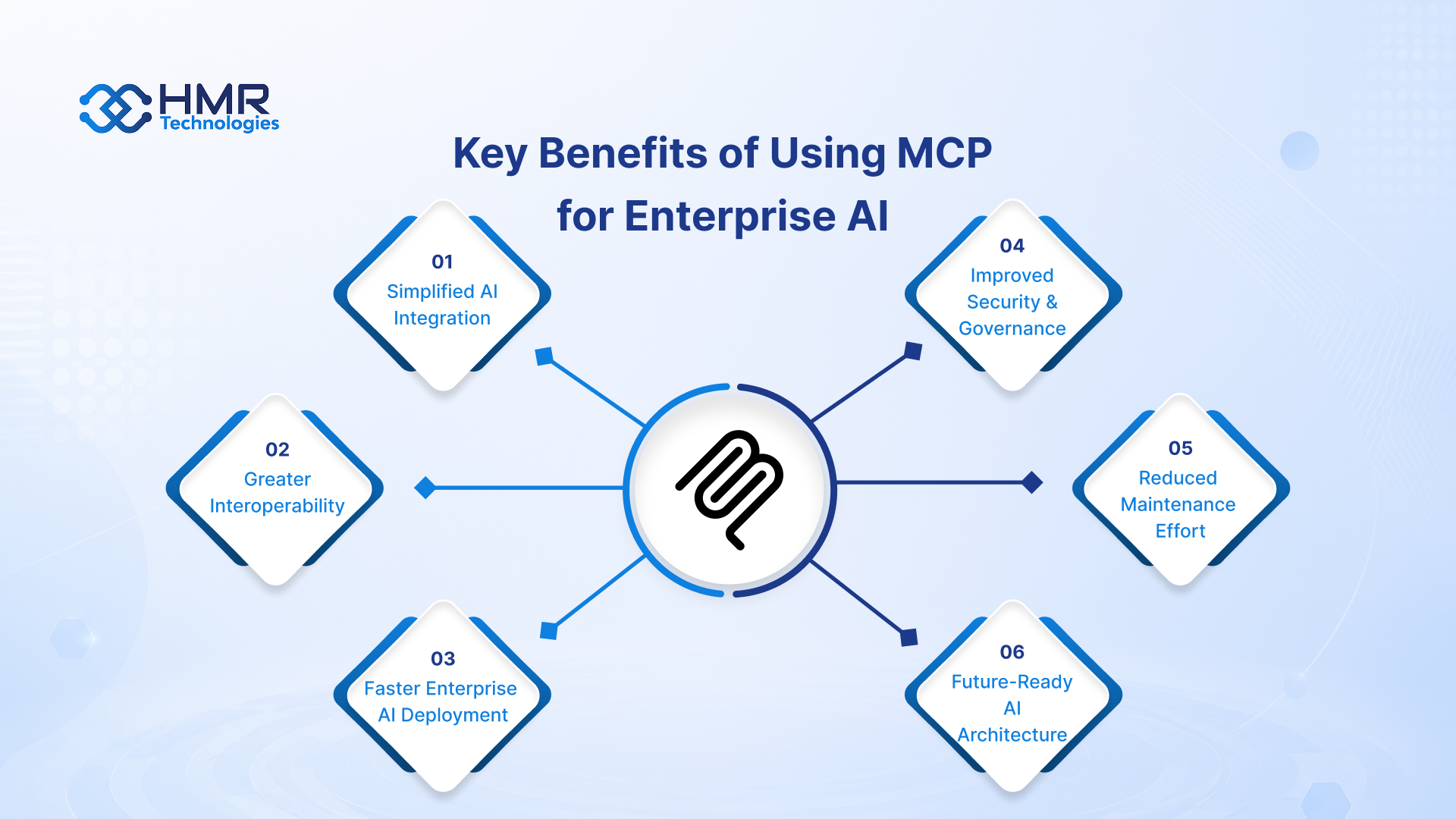
The growing interest in Model Context Protocol isn’t just about adopting another technical standard. It’s about solving one of the biggest challenges in enterprise AI—connecting intelligent applications with business systems efficiently and securely. As businesses continue to invest in enterprise AI trends, the need for a standardized integration framework like MCP has become increasingly important.
Simplified AI Integration
One of MCP’s biggest advantages is eliminating the need for repetitive custom integrations.
Instead of building unique connectors for every AI model and enterprise application, organizations can create reusable MCP servers that expose business capabilities through a standardized interface. This reduces development effort while making future AI projects easier to implement.
Greater Interoperability
Modern enterprises rarely rely on a single AI model or software platform.
MCP provides a common communication protocol that enables different AI applications to interact with multiple enterprise systems without requiring platform-specific integrations. This flexibility allows organizations to adopt new AI technologies without redesigning their entire integration architecture.
Faster Enterprise AI Deployment
Building custom integrations often becomes one of the longest phases of an AI project.
With standardized interfaces already in place, development teams can connect new AI assistants, copilots, and intelligent agents much faster. This accelerates deployment timelines and helps organizations realize business value sooner.
Improved Security and Governance
Enterprise AI applications frequently access sensitive business information.
MCP helps centralize how these interactions are managed by allowing organizations to apply consistent authentication, authorization, and access control policies across AI integrations. Rather than securing dozens of independent connectors, businesses can govern AI access through a more structured architecture.
Reduced Maintenance Effort
Custom integrations become increasingly difficult to maintain as AI ecosystems grow.
Because MCP standardizes communication between AI applications and enterprise systems, updates and enhancements can often be made in one place instead of across multiple individual integrations. This reduces ongoing maintenance while improving long-term scalability.
Future-Ready AI Architecture
AI technology continues to evolve rapidly.
Organizations that build tightly coupled integrations may face significant redevelopment efforts whenever they introduce new AI models or platforms. MCP helps reduce this dependency by creating a reusable integration layer that supports future AI initiatives with minimal disruption.
For enterprises investing in long-term digital transformation, MCP for enterprise AI provides a flexible foundation that supports innovation without increasing integration complexity.
Real-World Enterprise Use Cases of Model Context Protocol
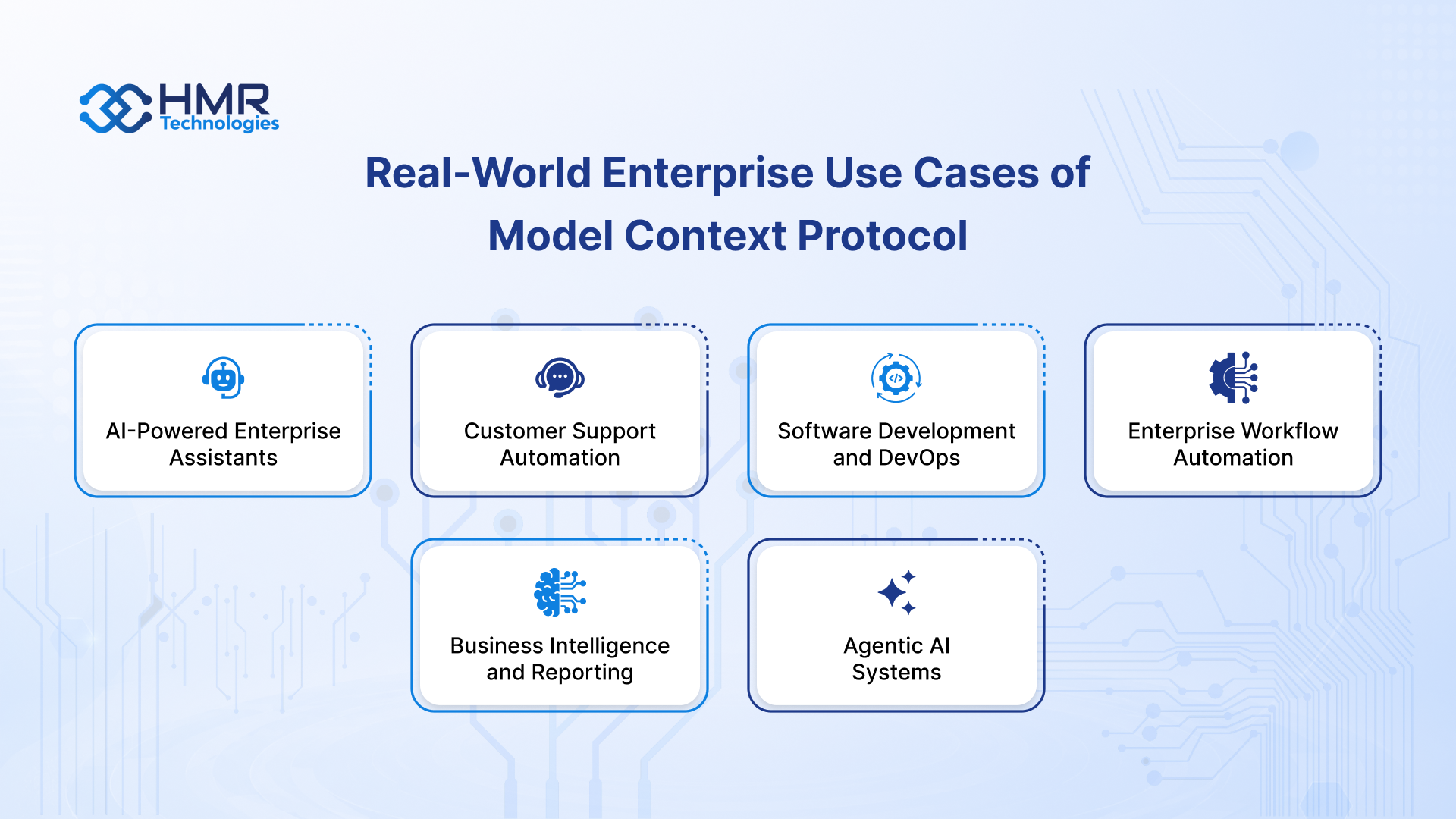
Model Context Protocol is designed to solve real integration challenges rather than simply introduce another technical standard. As enterprises expand their AI initiatives, MCP provides a practical way to connect intelligent applications with the systems employees use every day.
AI-Powered Enterprise Assistants
Many organizations are building AI assistants to help employees access company knowledge, retrieve documents, answer policy questions, and summarize business information. With MCP, these assistants can securely connect to internal knowledge bases, document management systems, and enterprise applications without requiring separate integrations for each platform.
Customer Support Automation
Support teams often rely on multiple systems, including CRMs, ticketing platforms, product documentation, and knowledge bases. MCP enables AI assistants to access these resources through a standardized interface, allowing customer queries to be resolved using accurate, real-time information.
Software Development and DevOps
Engineering teams can use MCP to connect AI coding assistants with Git repositories, CI/CD pipelines, issue trackers, and documentation platforms. Instead of switching between multiple tools, developers can retrieve project information, analyze code, and automate repetitive development tasks from a single AI interface.
Enterprise Workflow Automation
Organizations are increasingly using AI to automate internal processes such as approvals, reporting, document generation, and data retrieval. MCP allows AI systems to interact with multiple business applications while maintaining a consistent integration architecture, making workflow automation easier to scale.
Business Intelligence and Reporting
Business leaders often need information from ERP systems, CRM platforms, analytics dashboards, and financial applications. MCP enables AI assistants to gather data from these sources, generate summaries, and provide business insights without requiring custom integrations for every reporting tool.
Agentic AI Systems
One of the most promising use cases for MCP is supporting autonomous AI agents. Instead of simply responding to prompts, these agents can retrieve information, interact with enterprise applications, trigger workflows, and coordinate actions across multiple systems using standardized MCP interfaces.
MCP vs Traditional AI Integration Approaches
Many organizations begin their AI journey by building direct integrations between AI models and individual business applications. While this approach can work for small projects, it quickly becomes difficult to manage as AI adoption expands.
The table below highlights how Model Context Protocol differs from traditional integration approaches.
| Feature | Traditional AI Integration | Model Context Protocol (MCP) |
|---|---|---|
| Integration Approach | Custom connector for each application | Standardized protocol for all integrations |
| Development Effort | High as systems increase | Lower through reusable integrations |
| Scalability | Difficult to scale across multiple AI applications | Designed for enterprise-scale deployments |
| Maintenance | Multiple connectors require separate updates | Centralized integration management |
| AI Model Flexibility | Often tied to specific models or vendors | Model-agnostic architecture |
| Security Management | Distributed across individual integrations | Consistent authentication and access control |
| Enterprise Readiness | Suitable for limited implementations | Designed for complex enterprise ecosystems |
| Future Expansion | Additional integrations increase complexity | New AI applications can reuse existing MCP servers |
For organizations planning long-term AI adoption, MCP provides a more sustainable integration strategy. Rather than continuously building and maintaining custom connectors, enterprises can establish a reusable communication layer that supports future AI applications with significantly less development effort.
Why Choose HMR Technologies for Enterprise AI Integration?
Building enterprise AI solutions requires more than selecting the right language model. Success depends on designing an architecture that securely connects AI applications to existing business systems while remaining scalable as requirements evolve.
At HMR Technologies, our AI development services help organizations design and implement AI solutions that integrate seamlessly with enterprise platforms, cloud services, internal applications, and business workflows. Our team focuses on creating scalable AI architectures that support automation, intelligent decision-making, and long-term digital transformation.
Whether you’re exploring Model Context Protocol (MCP), developing AI-driven applications, or modernizing existing enterprise systems, our dedicated development team works closely with your organization to deliver scalable AI solutions.
By combining expertise in AI development, enterprise software engineering, and system integration, HMR Technologies helps organizations build connected AI ecosystems that are secure, maintainable, and ready for future growth.
Conclusion
Enterprise AI is no longer limited to answering questions or generating content. Modern AI applications are expected to interact with business systems, retrieve real-time information, automate workflows, and support complex decision-making across the organization.
As these capabilities continue to expand, managing AI integrations through custom connectors becomes increasingly difficult. The Model Context Protocol (MCP) addresses this challenge by providing a standardized way for AI models to communicate with enterprise applications, APIs, and data sources.
With benefits such as improved interoperability, simplified integration, stronger governance, and better scalability, MCP is quickly becoming an important foundation for enterprise AI architectures. Organizations that adopt standardized integration approaches today will be better positioned to scale future AI initiatives with less complexity and lower maintenance effort.
Whether you’re building AI assistants, intelligent agents, or enterprise automation solutions, Model Context Protocol provides a flexible framework for creating connected, secure, and future-ready AI ecosystems.

 June 26, 2026
 10 min read