




Introduction
Technology keeps changing the way businesses operate. And right now, machine learning is at the center of that change.
From fraud detection in banking to product recommendations on e-commerce platforms, ML is no longer a future concept. It is already running behind the scenes of the tools and services people use every day.
If you have started researching machine learning for your business, you have probably noticed one thing: Python shows up everywhere. Every course, every tutorial, and every ML job post defaults to Python. That is not a coincidence.
To turn these advanced algorithms into secure, enterprise-grade applications, businesses rely on specialized python development services to build a solid and scalable backend infrastructure.
There are solid, practical reasons why developers and data scientists worldwide prefer Python for machine learning. This guide breaks all of that down in simple language, no jargon, no fluff.
Here is what you will learn:
- Why Python is used for machine learning over other languages
- Which Python libraries power most AI and ML projects today
- How your business can take a realistic first step into ML development
Let’s get into it.
Understanding Machine Learning and Its Business Impact
Before jumping into Python, it helps to understand what machine learning actually does and why businesses care about it.
Machine learning is a branch of artificial intelligence. Instead of programming a system with fixed rules, you feed it data and let it learn patterns on its own. Over time, the system improves at making predictions and decisions without manual updates.
Businesses are already using this in very practical ways:
- Retail — predicting demand and managing inventory
- Banking — detecting fraudulent transactions in real time
- Healthcare — assisting with early diagnosis and patient data analysis
- E-commerce — personalizing product recommendations for each user through custom AI solutions tailored to customer behavior and business data.
- Customer support — automating responses and reducing ticket volume
The common thread across all these use cases? Most of them are built using Python.
Understanding this connection is the first step. Now, let’s look at why Python specifically became the go-to choice.
Why Is Python Used for Machine Learning?
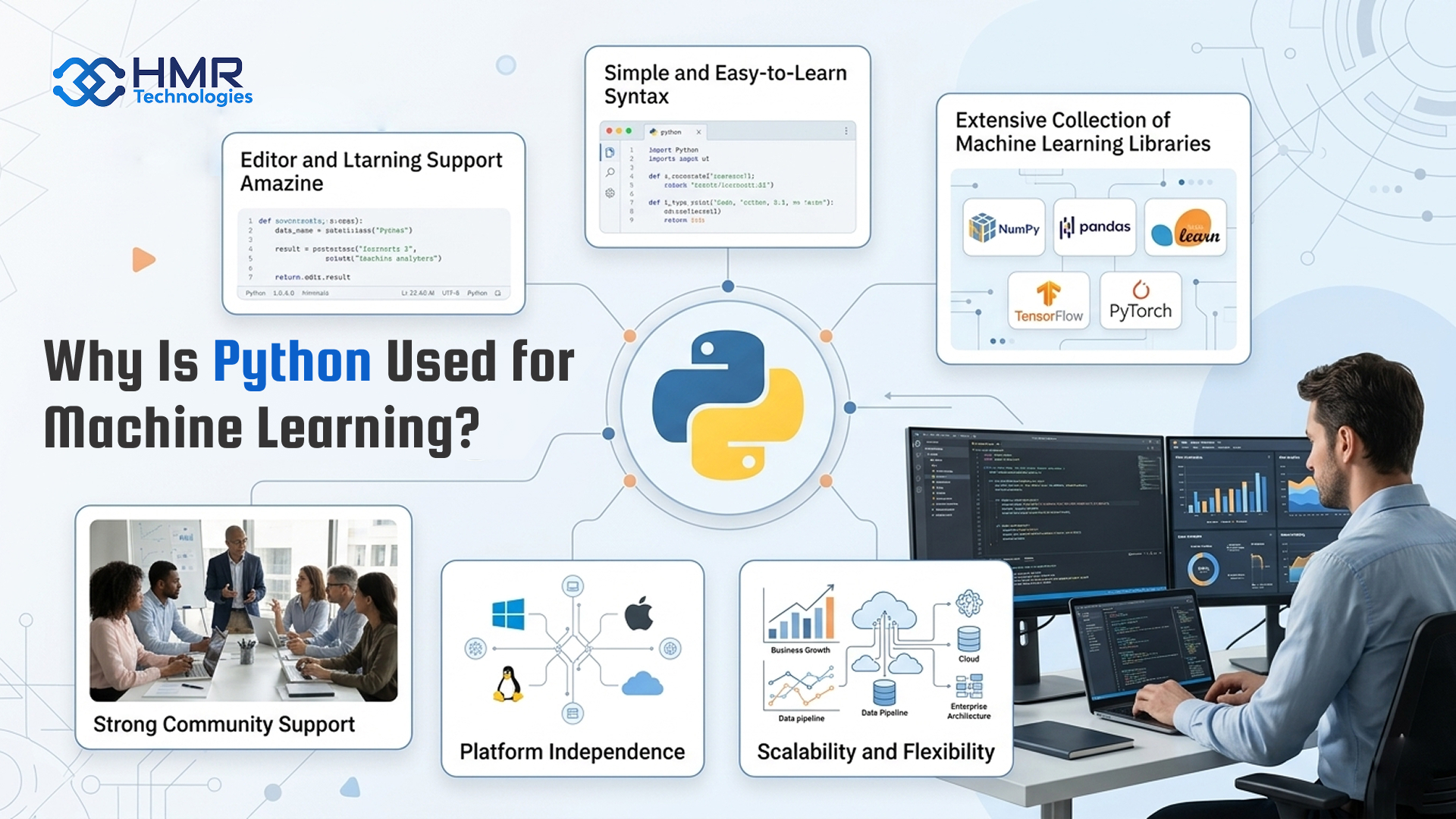
This is the question most business owners and technical managers ask when they first start exploring ML. The answer comes down to five core reasons.
Simple and Easy-to-Learn Syntax
One of the first things people notice about Python is how readable it is. It almost reads like structured English. You do not need years of programming experience to understand what a script is doing.
For machine learning projects, this matters more than it sounds.
ML teams are rarely made up of just one type of person. You have data scientists, software engineers, and business analysts all working on the same project. Python is one of the few languages where all three can read and work in the same codebase without friction.
When you are running experiments and iterating quickly on data, the last thing you want is a language slowing you down. Python stays out of the way and lets you focus on the actual problem.
Extensive Collection of Machine Learning Libraries
If there is one reason why Python for machine learning became the global standard, this is it.
Python has a mature, well-maintained library for every stage of the ML workflow. Data cleaning, model training, evaluation, visualization, deployment — there is a reliable tool for each step.
These libraries were not built overnight. They have been developed and refined by thousands of contributors over many years, and stress-tested in real production environments.
When your team uses them, they are not reinventing the wheel. They are building on a foundation that already works.
Strong Community Support
Python machine learning developers are widely available in the job market, making it easier for companies to build dedicated development teams for long-term AI and software initiatives.
When a developer hits a problem, there is almost always a detailed answer already waiting on Stack Overflow, GitHub, or a community forum. That alone saves hours of debugging time on every project.
There is also a hiring advantage worth noting. Python machine learning developers are widely available in the job market. New team members ramp up faster. And that community knowledge quietly reduces your development costs over the life of a project.
Platform Independence
Python runs on Windows, macOS, and Linux without requiring significant changes to the code.
Your data scientist builds on a MacBook. Your team deploys on a Linux cloud server. It just works, no environment-specific issues, no last-minute compatibility fixes before launch.
For businesses still scaling their infrastructure, that kind of consistency removes an entire category of operational headaches.
Scalability and Flexibility
The most common criticism of Python is that it is slow. Technically, that is true for Python code itself, but it misses how ML in Python actually works.
The libraries doing the heavy lifting, NumPy, TensorFlow, and PyTorch, are written in C and C++ at their core. When your model is processing millions of data points, it is that optimized compiled code running, not Python.
Python simply provides the interface. Clean and readable on the surface, high-performance underneath. For most business ML applications, that balance is exactly what you need, especially when machine learning is being integrated into broader custom software development projects.
Top Python Libraries Used for Machine Learning
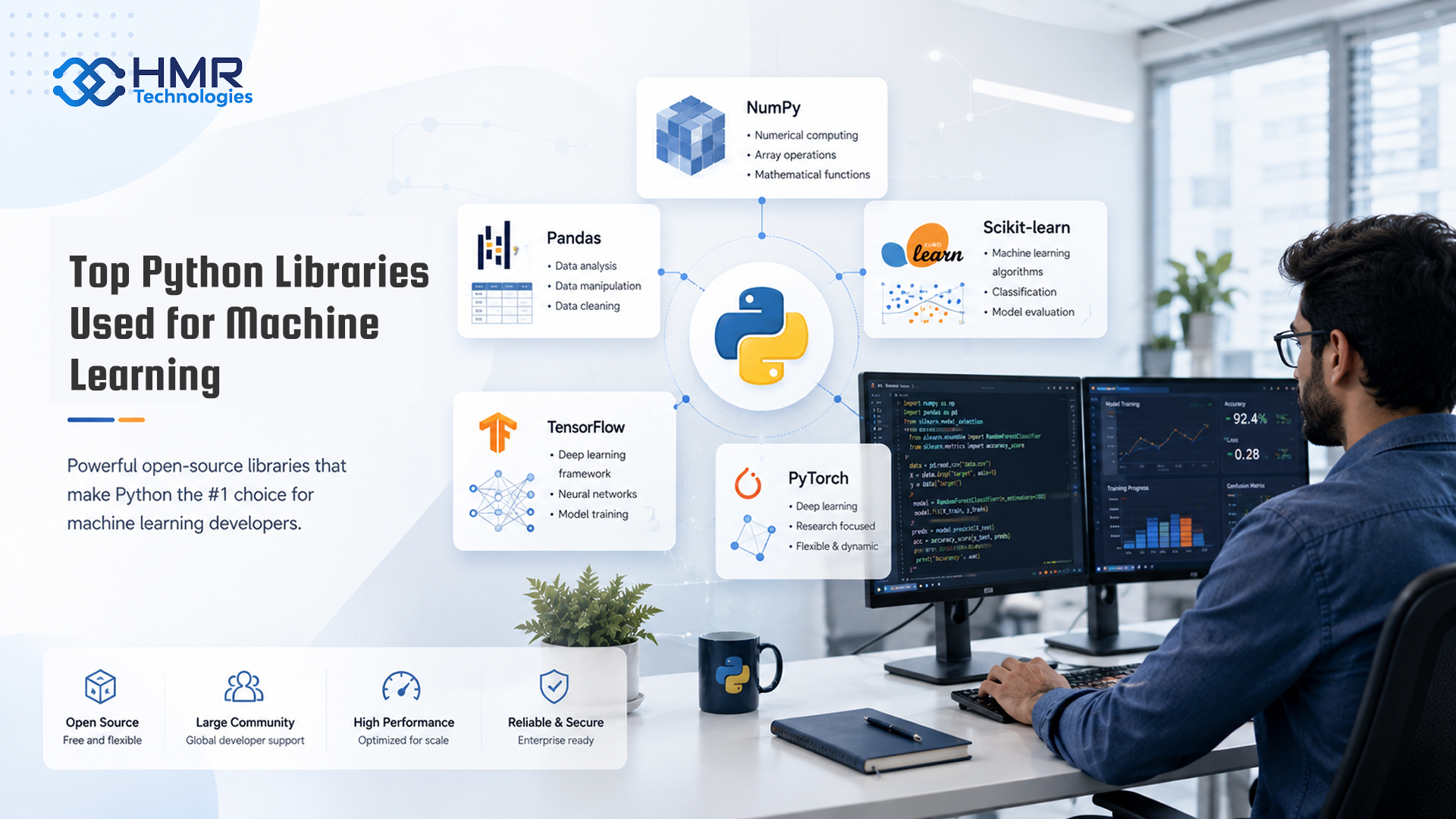
To understand the practical landscape of machine learning tools Python developers rely on, we need to look at the standard enterprise data stack. These libraries are not just tools, they form the actual pipeline that processes raw data and turns it into intelligent actions. If you are working with a team that offers dedicated Python development services, these are the libraries they will be working with on a daily basis.
1. NumPy (Numerical Python)
NumPy is the foundational mathematical engine for almost every data science tool in the ecosystem. It introduces a powerful N-dimensional array object that allows developers to perform lightning-fast vectorized mathematical calculations.
Role in ML: It processes large multi-dimensional matrices and complex mathematical arrays efficiently, bypassing the performance bottlenecks of standard Python loops.
Best Used For: High-performance linear algebra computations, array manipulations, and Fourier transforms.
2. Pandas
Data is almost never clean when it arrives from production databases. It contains missing fields, mismatched formats, and duplicate records. Pandas is the ultimate data wrangling and manipulation toolkit.
Role in ML: It provides highly intuitive data structures like DataFrames, allowing engineers to clean, filter, reshape, and analyze structured data with minimal code.
Best Used For: Time-series analysis, merging distinct database tables, handling missing data points, and exploratory data analysis (EDA).
3. Scikit-learn
When it comes to classical machine learning, Scikit-learn is the undisputed industry gold standard. Built on top of NumPy and Pandas, it provides a clean, unified API for a massive array of machine learning algorithms.
Role in ML: It handles everything from data preprocessing (scaling, encoding) to training standard machine learning models and evaluating their accuracy.
Best Used For: Customer churn prediction (Classification), sales forecasting (Regression), market segmentation (Clustering), and feature engineering.
4. TensorFlow
Developed by Google, TensorFlow is an end-to-end open-source platform built for large-scale, enterprise-grade deep learning deployment.
Role in ML: It allows developers to build, train, and deploy massive neural networks across distributed multi-GPU clusters.
Best Used For: Enterprise production deployments, edge-device ML integration (via TensorFlow Lite), and large-scale industrial computer vision applications.
5. PyTorch
Developed by Meta’s AI Research lab, PyTorch has quickly become the absolute favorite framework within both research academies and cutting-edge engineering teams.
Role in ML: It uses a dynamic computation graph, meaning the structure of the neural network can be modified on the fly during runtime. This makes debugging incredibly intuitive.
Best Used For: Natural Language Processing (NLP), custom Generative AI modeling, training Large Language Models (LLMs), and rapid prototype development.
Is Machine Learning only for Python?
No and it is worth being direct about this.
Machine learning is not exclusive to Python. R is widely used in statistical research and academia, particularly in healthcare and social sciences. Julia is gaining traction for high-performance numerical computing.
Java and Scala are common in enterprise big data environments built around Apache Spark. C++ appears in performance-critical applications like embedded systems and real-time inference.
So why does Python dominate in practice?
Because it sits at the intersection of ease of use, library depth, and industry adoption in a way nothing else currently does. Major cloud platforms AWS SageMaker, Google AI Platform, Azure Machine Learning provide their most complete SDK support for Python. Most published ML research includes Python code first. Most ML talent entering the job market already knows Python.
Other languages have their place, but for a business building machine learning capabilities today, Python is the most practical and cost-effective starting point by a significant margin.
How Businesses Can Get Started with Python Machine Learning Development
Getting started with ML does not have to be complicated. The key is approaching it in the right order with the right partner by your side.
Start by defining a real business problem. Not “we want to use AI,” but something specific and measurable, reducing churn, automating data processing, improving forecast accuracy. A focused problem leads to a focused solution.
Before any development begins, audit your data. Clean, well-structured data is the actual foundation of any ML system. Most project delays trace back to data issues that were ignored at the start.
From there, keep your first build small. An MVP development approach focused on one real use case will teach your team more than months of planning. Python’s ecosystem makes this phase faster and more affordable than most businesses expect.
And if your team is new to this space, working with an experienced development partner makes a measurable difference. At HMR Technologies, we help startups and enterprises build Python-based ML solutions that are practical, scalable, and aligned with real business goals, not just technically impressive demos.
Whether you are exploring ML for the first time or looking to expand an existing system, our team is ready to help you move from idea to working product.
Conclusion
Python’s position as the leading language for machine learning is not a trend or a marketing narrative. It is the result of years of real-world usage, deep community investment, and practical advantages that no other language has come close to matching.
For businesses exploring ML, Python offers a proven, scalable foundation with mature tooling, a deep talent pool, and a clear path from prototype to production.
The question is no longer whether Python is the right choice for machine learning. That conversation is largely settled. The real question is how your business is going to start putting it to work.



 July 18, 2026
 10 min read