





Choosing a frontend framework isn’t just a technical decision. It influences how quickly a product reaches the market, how easily new features can be introduced, and how much effort goes into maintaining the application over time.
Many development teams start with one goal building a fast and responsive web application.
As the product grows, new challenges appear. The codebase grows, user expectations change, and adding new functionality often takes longer than expected. Following proven strategies to reduce software product development complexity can make long-term maintenance much easier.
That’s where the choice of framework starts to matter.
Over the years, Vue.js has become a popular JavaScript framework for businesses looking to build modern web applications without adding unnecessary complexity. Since its initial release by Evan You in 2014, Vue.js has evolved from a personal side project into one of the world’s most widely adopted frontend frameworks. Today, organizations such as Alibaba, Xiaomi, GitLab, and Adobe use Vue.js in various products, reflecting the framework’s maturity and ability to support applications at scale.
Another reason for its growing adoption is flexibility. Vue.js doesn’t force teams to follow a rigid development approach. It can power a single interactive component, an enterprise dashboard, a SaaS platform, or an entire frontend application while remaining easy to maintain as business requirements evolve.
In this Vue.js development guide, we’ll explore what makes the Vue.js framework stand out, the improvements introduced in Vue.js 3, and how businesses are building real-world web applications with Vue.js 3 to create fast, scalable, and engaging digital experiences.
What Is Vue.js Development?
Not every web application needs a complex frontend architecture.
Every web application starts with an idea. Keeping that application fast, interactive, and easy to maintain as it grows is where the real challenge begins.
That’s exactly what Vue.js development is designed for.
Vue.js is an open-source JavaScript framework used to build modern user interfaces and single-page applications (SPAs). Instead of reloading an entire page after every interaction, it updates only the parts of the interface that change. The result is a faster and more responsive user experience.
What sets the Vue.js framework apart is its flexibility.
Teams don’t have to rebuild an entire application to adopt Vue.js. Businesses that need additional frontend expertise can also hire dedicated developers to accelerate project delivery. That makes it a practical choice for both startups launching an MVP and enterprises modernizing legacy applications.
From SaaS products and customer portals to eCommerce platforms, CRM systems, and Progressive Web Apps (PWAs), Vue.js supports a wide variety of business applications. Its balance of simplicity, performance, and scalability has made it one of the most trusted frontend frameworks for modern web development.
Why Businesses Choose Vue.js for Modern Web Applications
Building a modern web application isn’t just about launching a product. It’s about choosing technologies that can support new features, growing user demands, and changing business requirements without slowing development.
That’s one of the reasons Vue.js continues to be a preferred frontend framework for businesses of all sizes.
Its biggest strength lies in its simplicity. Developers can build interactive interfaces without dealing with unnecessary complexity, making it easier to deliver products faster while keeping the codebase clean and maintainable through Vue.js development services.
As applications grow, that simplicity becomes even more valuable.
With its component-based architecture, Vue.js allows teams to reuse interface elements instead of building the same functionality repeatedly. This reduces development effort and makes future updates easier to manage.
Performance is another reason businesses choose Vue.js. It updates only the parts of the interface that change, creating faster interactions and a smoother user experience across customer portals, admin dashboards, SaaS platforms, and other web applications.
A mature ecosystem, strong community support, and official tools for routing, state management, testing, and debugging make Vue.js a reliable choice for long-term development.
For businesses, the value extends beyond the framework itself. Vue.js helps accelerate development, simplifies maintenance, and provides a strong foundation for applications that need to grow with the business.
Key Features of the Vue.js Framework
Vue.js isn’t popular because of a single feature. Its strength comes from a collection of capabilities that make frontend web development faster, more organized, and easier to scale.
Each feature is designed to solve a practical development challenge, helping teams spend less time managing code and more time improving the product.
Reactive Data Binding
Keeping the user interface synchronized with application data can quickly become complicated in large projects.
Vue.js simplifies this through reactive data binding. Whenever the underlying data changes, the interface updates automatically without requiring developers to manually refresh individual elements. This reduces repetitive code and helps create a smoother user experience.
Virtual DOM
Performance becomes increasingly important as applications grow.
Vue.js uses a Virtual DOM to identify exactly what has changed before updating the browser. Instead of re-rendering an entire page, it updates only the affected elements. This approach improves rendering speed and keeps applications responsive, even when handling complex user interactions.
Component-Based Architecture
Large applications become easier to manage when they’re built in smaller, reusable pieces.
Vue.js follows a component-based architecture where elements such as navigation bars, dashboards, forms, and product cards are developed as independent components. These components can be reused across multiple pages, making development more consistent and simplifying future updates.
Single File Components (SFCs)
Organizing frontend code becomes much easier with Single File Components.
Each component keeps its template, logic, and styles together in a single file. Developers don’t have to switch between multiple files to make changes, improving readability and making collaboration more efficient.
Routing with Vue Router
Most business applications include multiple pages or views.
Vue Router provides a structured way to manage navigation without reloading the entire page. Users experience faster transitions between screens, while developers can build clean, scalable navigation for dashboards, customer portals, and other complex applications.
State Management with Pinia
As applications grow, different components often need access to the same data.
Pinia provides a centralized way to manage application state, ensuring information remains consistent across the interface. This becomes especially useful in SaaS platforms, eCommerce applications, and enterprise software where multiple features depend on shared data.
TypeScript Support
Many development teams prefer TypeScript for large-scale projects because it improves code reliability.
Vue.js offers excellent TypeScript support, allowing developers to catch errors earlier, write more maintainable code, and manage complex applications with greater confidence.
Vue DevTools
Debugging is an essential part of every development project.
Vue DevTools gives developers visibility into components, application state, events, and performance. Instead of spending hours tracing issues manually, teams can identify problems faster and improve development efficiency.
Vue.js 3: What’s New and Why It Matters
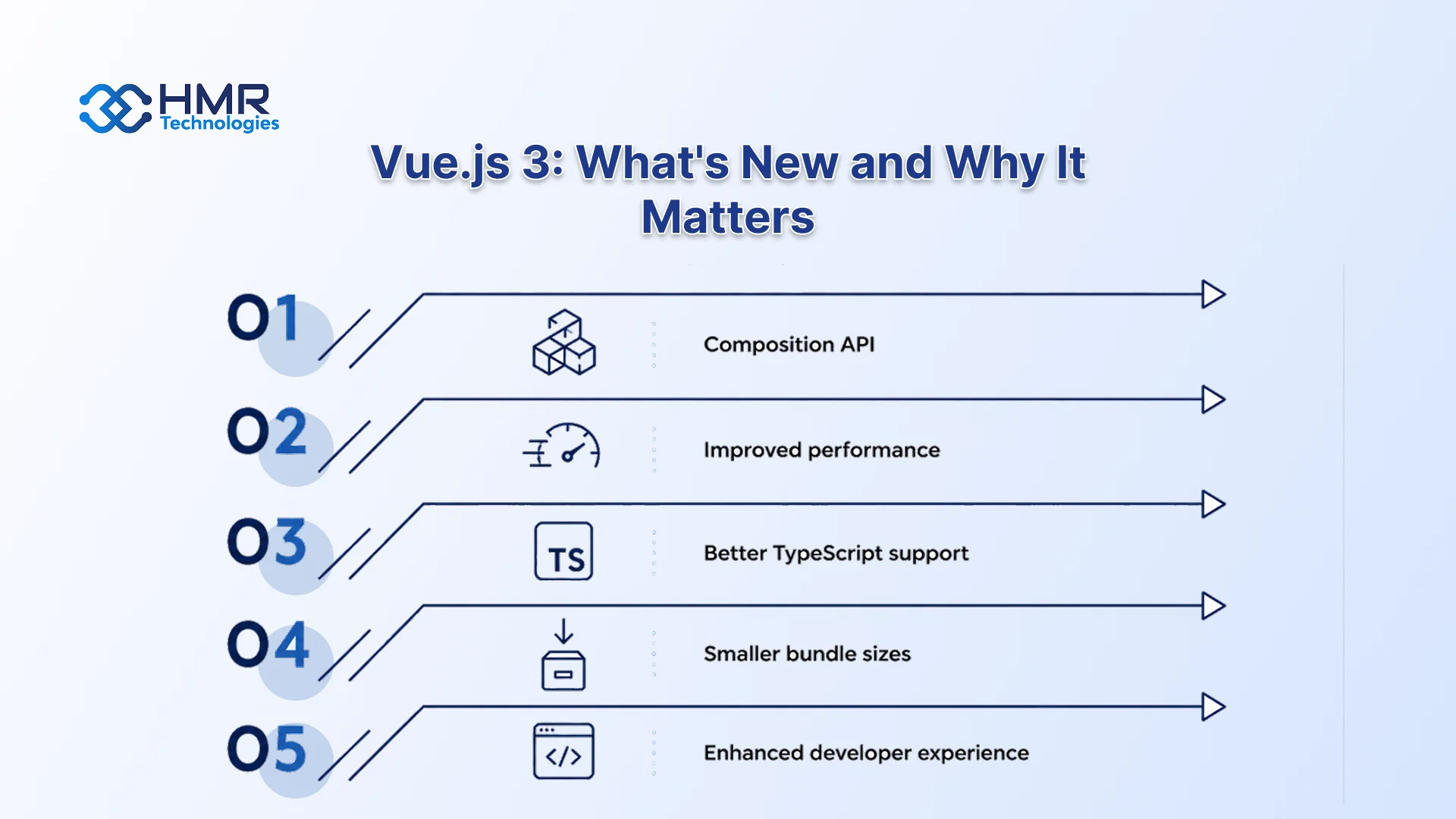
Vue.js 3 isn’t a complete reinvention of the framework. Instead, it builds on what developers already appreciate while introducing improvements that make applications faster, easier to maintain, and better suited for large-scale projects.
Composition API
As applications grow, organizing code becomes more challenging.
The Composition API offers a more flexible way to structure application logic. Instead of grouping code by component options, developers can organize related functionality together, making complex components easier to understand, reuse, and maintain.
It’s especially useful for large applications where multiple features share common logic.
Improved Performance
Every improvement in application speed contributes to a better user experience.
Vue.js 3 delivers noticeable performance enhancements with faster rendering, quicker updates, and lower memory consumption. These optimizations help applications remain responsive, even as they handle more data and user interactions.
Better TypeScript Support
TypeScript has become a preferred choice for enterprise development because it helps catch errors before code reaches production.
Vue.js 3 was built with stronger TypeScript integration, making it easier for development teams to create reliable, maintainable applications while improving collaboration across larger projects.
Smaller Bundle Sizes
Application performance isn’t only about writing efficient code. The amount of JavaScript delivered to the browser also matters.
Vue.js 3 reduces bundle sizes through improved architecture and better tree-shaking support. Smaller bundles load faster, improving page speed and overall user experience, particularly on mobile devices and slower networks.
Enhanced Developer Experience
A productive development environment often translates into faster product delivery.
Vue.js 3 introduces improvements across its tooling, debugging capabilities, and development workflow, helping teams spend less time solving framework-related issues and more time building new features. The result is a smoother development experience from the prototype to production.
The improvements introduced in Vue.js 3 aren’t just technical upgrades. They address the everyday challenges development teams face when building applications that need to scale, perform consistently, and remain easy to maintain over time. That’s why many businesses continue choosing Vue.js 3 as the foundation for modern web applications.
Building Real-World Web Applications with Vue.js 3

Vue.js 3 is used across industries because it adapts to different business requirements without adding unnecessary complexity. Its flexibility and performance make it suitable for applications of all sizes.
Here are some of the most common use cases:
SaaS Platforms
- Develop scalable, subscription-based applications with responsive user interfaces.
- Support real-time updates, user management, and API-driven functionality.
- Simplify feature releases as the product grows.
Admin Dashboards
- Create interactive dashboards with charts, reports, and analytics.
- Handle dynamic data efficiently without affecting performance.
- Improve usability with responsive and intuitive interfaces.
CRM Systems
- Build centralized platforms for managing customer information and sales activities.
- Organize complex workflows using reusable UI components.
- Deliver a consistent experience across different user roles.
E-commerce Applications
- Build fast product catalogs, shopping carts, and checkout experiences.
- Integrate with payment gateways, inventory systems, and third-party services.
- Enhance customer engagement with responsive product browsing.
Enterprise Portals
- Develop secure portals for employees, customers, or business partners.
- Support role-based access, document management, and internal workflows.
- Scale applications as business operations expand.
Progressive Web Apps (PWAs)
- Deliver app-like experiences directly through the browser.
- Enable offline access and faster loading times.
- Provide a consistent experience across desktop and mobile devices.
Why Choose HMR Technologies for Vue.js Development?
A successful Vue.js project depends on more than choosing the right framework. It requires a team that understands your product, business goals, and the challenges that come with building scalable web applications.
At HMR Technologies, we focus on creating Vue.js solutions that are fast, maintainable, and built for long-term growth. Whether it’s a startup MVP, a SaaS platform, or an enterprise application, our development approach is tailored to the unique requirements of every project.
Our team follows modern development practices, writes clean and maintainable code, and works closely with clients throughout the development process. This helps ensure every application is easy to scale, integrate, and support as business needs evolve.
From custom web applications and enterprise portals to CRM systems and eCommerce platforms, we’ve helped businesses turn ideas into reliable digital products. Our goal isn’t just to deliver software—it’s to build solutions that continue creating value long after deployment.
If you’re looking for a technology partner with hands-on experience in Vue.js development, HMR Technologies is ready to help you bring your next web application to life.
Conclusion
Choosing a frontend framework is a decision that influences much more than the development process. It affects how quickly products are delivered, how easily new features can be introduced, and how well an application supports future business growth.
Vue.js has earned its place as one of the most reliable frontend frameworks by combining performance, flexibility, and a developer-friendly architecture. From SaaS platforms and enterprise portals to CRM systems and eCommerce applications, it provides a strong foundation for building modern web experiences that are fast, scalable, and easy to maintain, making it one of the
If you’re planning to build a new web application or modernize an existing one, investing in professional Vue.js development can help you create a solution that delivers long-term value for both your business and your users.
At HMR Technologies, we help businesses turn ideas into high-quality Vue.js applications with a focus on performance, scalability, and long-term success. Whether you’re starting from scratch or enhancing an existing product, our team is ready to bring your vision to life.



 July 13, 2026
 10 min read