




Introduction
Software product development often looks simple at the idea stage, but it becomes surprisingly
complex very quickly once execution begins. New features get added, teams grow, timelines tighten, and before you know it, complexity starts to slow down delivery, increase costs, and affect product quality.
Research shows this isn’t just a feeling, it’s reality. Multiple industry reports reveal that up to 70–75% of software projects fail to meet their objectives, timelines, or budgets due to various issues during development.
Many projects run over budget, fall behind schedule, or are partially or completely unsuccessful. Roughly 19% of projects completely fail, and nearly half go over budget or time expectations.
Most of these problems don’t happen because the idea was bad. Instead, development becomes hard to manage due to unclear requirements, confusing processes, and growing technical challenges that pile up over time.
These principles are especially important in Custom Software Development for Enterprises, where scalability, maintainability, and long-term performance directly impact business success.
In this blog, we’ll explain what software product development complexity really means and share practical ways to reduce complexity in software product development, drawing on real industry experience and proven Software Product Engineering practices.
What Is Software Product Development Complexity?
Software Product development complexity means how difficult it is to build, update, and maintain a software product. This difficulty does not come only from the code.
In the software product development process, complexity can come from unclear planning, poor communication, wrong technology choices, or rushed decisions.
When a system becomes too complex, even small changes take more time and effort. Over time, this slows down innovation and increases costs, and makes scaling the product harder, especially in fast-changing enterprise software development trends.
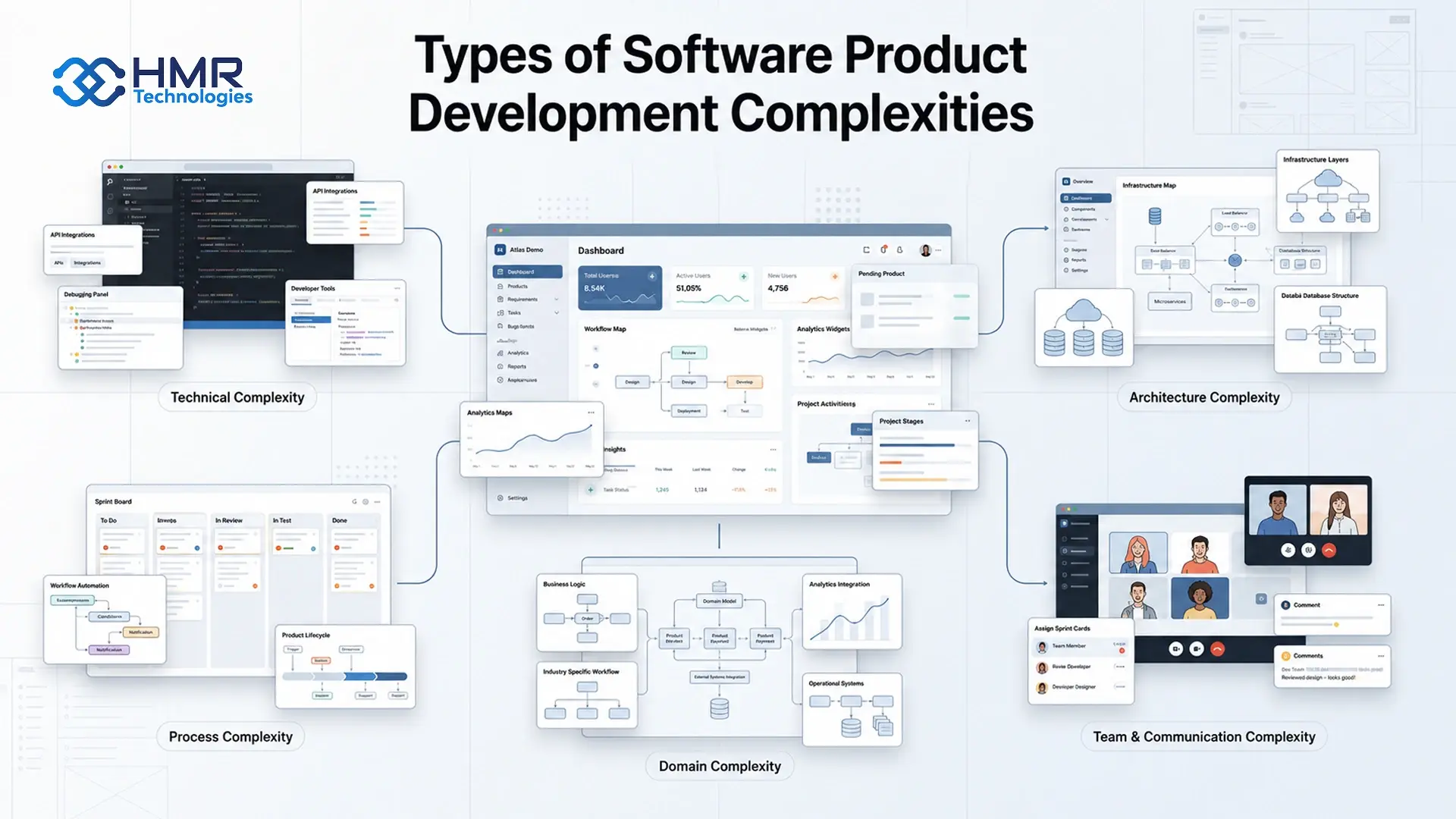
Types of Software Product Development Complexities
1. Technical Complexity
Technical complexity happens when code is hard to read, poorly structured, or tightly connected. Small changes can break multiple features.
This usually happens when teams skip code reviews or avoid improving old code.
2. Architecture Complexity
Architecture complexity appears when systems are over-designed. Using too many tools, services, or integrations without real need increases confusion.
Choosing the wrong frameworks for web development can also create long-term problems if the team struggles to maintain them.
3. Process Complexity
Process complexity happens when there are too many steps involved in getting work done. Extra approvals, unclear workflows, and using too many tools can slow the entire development process.
Instead of focusing on building the product, teams end up spending more time tracking tasks, waiting for approvals, and managing tools.
4. Domain & Compliance Complexity
Domain complexity comes from the industry or problem the software is built for. Every industry works differently, and some domains naturally have more rules, validations, and constraints than others.
For example, software built for healthcare, finance, or aerospace must follow strict regulations and industry compliance standards such as GDPR and HIPAA. These regulations define how data is stored, processed, secured, and shared, adding an extra layer of complexity to the software development process.
5. Team and Communication Complexity
As teams grow, communication gaps increase. Developers, designers, and business teams may not always be on the same page.
This leads to misunderstandings, rework, and missed expectations.
How to Reduce Complexities in Software Development
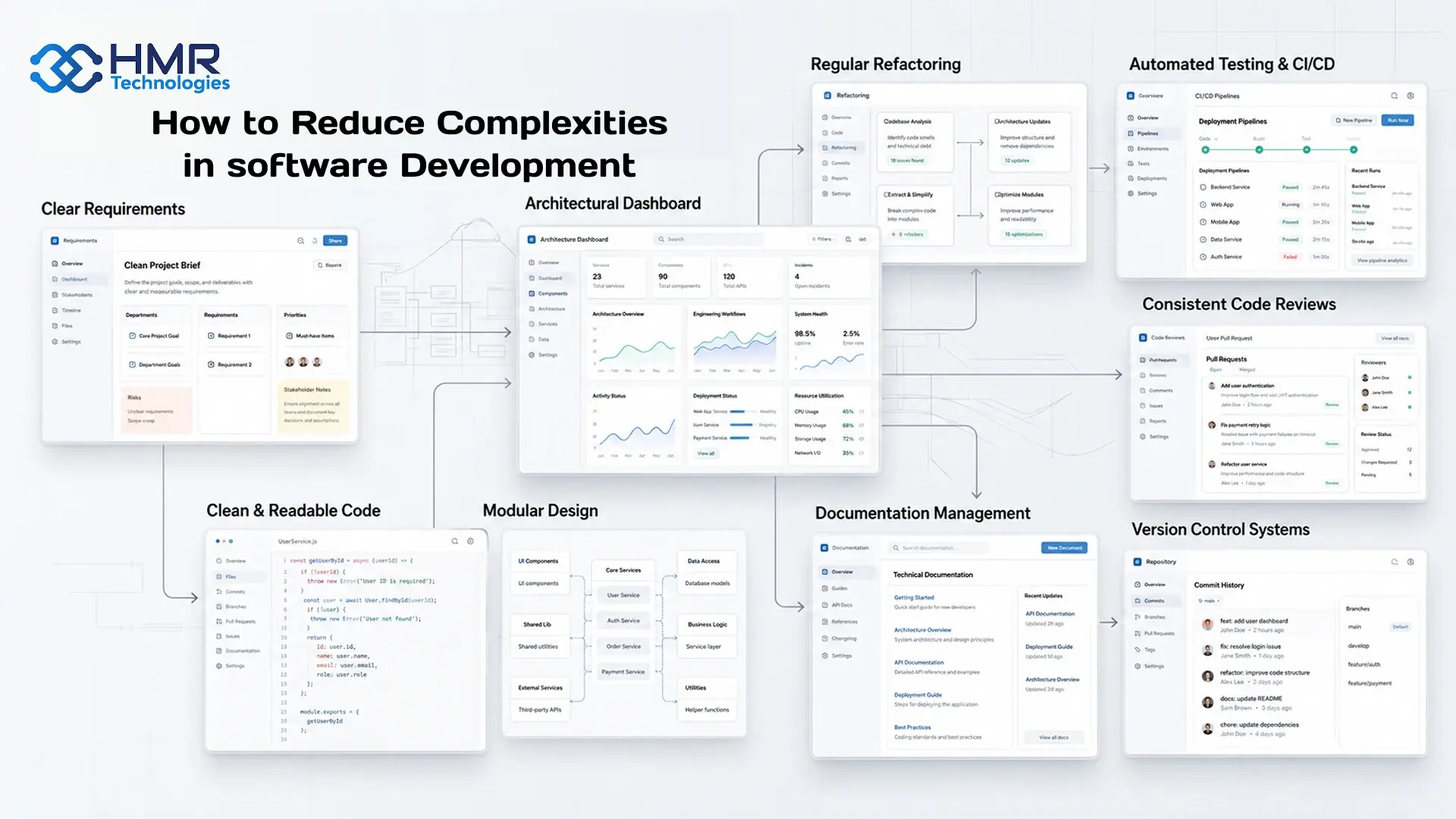
Reducing complexity in software product development is not about shortcuts. It is about making thoughtful decisions at every stage, from planning to delivery and beyond.
The following practices are proven ways developers and product teams reduce complexity in real-world custom software development projects.
Keep Requirements Clear and Simple
Complexity often starts before development even begins. When requirements are unclear or constantly changing, teams end up building features based on assumptions instead of real needs.
Every feature should have a clear purpose and business value. If a requirement cannot be explained in simple terms, it usually means it is not fully understood yet.
Spending extra time clarifying requirements early saves weeks of rework later. Well-documented and validated requirements give developers confidence and direction.
Write Clean and Readable Code
Clean code is the foundation of a simple software system. It focuses on clarity, proper naming, and consistent structure rather than clever or overly optimized solutions.
When code is easy to read, developers can understand it quickly without spending hours trying to figure out what it does.
This reduces bugs, speeds up development, and makes future updates much smoother. Clean code also helps new team members onboard faster and contribute with confidence.
Implement Modular Design
Modular design means breaking a large system into smaller, independent parts, where each module handles a specific responsibility. This prevents the entire system from becoming tightly connected and difficult to change.
When modules are well-defined, teams can update or replace one part without affecting others. This approach makes testing easier, improves system stability, and allows the product to grow without adding unnecessary complexity.
Conduct Regular Refactoring
Refactoring is the process of improving existing code without changing its behavior. Over time, even well-written code can become messy due to quick fixes and new feature additions.
Regular refactoring helps remove duplicated logic, simplify complex functions, and improve overall code structure. This keeps the codebase healthy and prevents small issues from turning into long-term technical debt.
Automate Testing and Continuous Integration
Manual testing alone is not enough as software grows.
Automated testing ensures that new changes do not break existing functionality and helps catch issues early in the development cycle.
Continuous integration allows developers to merge code frequently and automatically test it. This reduces last-minute surprises, improves code quality, and makes releases more predictable and less stressful.
Perform Code Reviews Consistently
Code reviews are an important practice for maintaining quality and consistency. They allow team members to review each other’s work, identify potential issues, and suggest improvements.
Regular code reviews also promote knowledge sharing and prevent bad practices from spreading across the codebase. Over time, this leads to better design decisions and a more stable product.
Maintain Clear and Useful Documentation
Good documentation explains how the system works and why certain technical decisions were made. It does not need to be long, but it should be clear and up to date.
Effective documentation helps developers understand the system faster, reduces dependency on individual team members, and supports smoother maintenance and future development.
Use Version Control Systems Effectively
Version control systems track every change made to the codebase and make collaboration easier across teams. They allow developers to work safely without the risk of losing or overwriting code.
With proper version control practices, teams can review changes, roll back mistakes, and manage releases in an organized way. This brings structure and reliability to the entire development process.
The Impact of Complexity on Product Projects
Unmanaged complexity slows down software development and makes even small changes difficult. Teams spend more time understanding the system than building new features, which delays delivery.
As the codebase becomes more complicated, development speed drops. Simple updates take longer to implement, review, and test, increasing overall effort.
Complexity also raises development and maintenance costs. Frequent bugs, rework, and dependency issues force teams to spend more time fixing problems instead of improving the product.
Team productivity suffers as well. Developers feel frustrated, onboarding new members becomes harder, and the project often depends on a few individuals who understand the system.
Over time, this complexity turns into technical debt, making it difficult to scale the product or adapt to new business requirements.
Common Mistakes That Increase Complexity
Software complexity often increases because of small mistakes made during planning and development. These issues may seem minor at first, but they slowly grow into serious problems that affect the entire product.
-
Unclear or changing requirements — Starting development without clear requirements leads to confusion, rework, and wasted effort.
-
Over-engineering the solution — Adding unnecessary features, tools, or architecture makes the system harder to understand and maintain.
-
Ignoring code quality and refactoring — Avoiding regular code cleanup allows technical debt to build up over time.
-
Poor communication within the team — Lack of alignment between developers, product teams, and stakeholders results in incorrect implementations.
-
Choosing technology without a long-term vision — Selecting tools based only on trends can create scalability and maintenance challenges later.
Avoiding these common mistakes helps teams keep software development simple, efficient, and easier to scale over time.
Conclusion
Reducing complexity in software product development is not about cutting corners or limiting innovation. It is about making thoughtful decisions that keep the product simple, scalable, and easy to maintain over time.
From clear requirements and clean code to modular design, automation, and strong communication, every small practice plays an important role in controlling complexity.
When teams address complexity early, they avoid technical debt, reduce costs, and deliver higher-quality products faster.
Software projects succeed when simplicity is treated as a priority, not an afterthought. Teams that focus on clarity, structure, and long-term thinking are better prepared to adapt to changing business needs and market demands.
With the right Software Product Engineering approach and experienced partners like HMR Technologies, businesses can build software products that remain stable, flexible, and future-ready without unnecessary complexity slowing them down.



 July 18, 2026
 10 min read