




Introduction
Artificial intelligence is no longer limited to large enterprises with massive budgets. Startups, SaaS companies, healthcare providers, fintech firms, and eCommerce brands are actively partnering with a trusted Mobile app Development company to build AI-powered applications that automate workflows, improve customer experiences, and support faster business decisions.
However, one question still dominates the early planning stage:
How much does AI app development cost in 2026?
The answer depends on multiple factors, including the type of AI model, app complexity, infrastructure, integrations, development location, and ongoing training requirements.
A simple AI-enabled mobile app may cost around $20,000 to $50,000, while enterprise-grade AI platforms with custom machine learning models, generative AI capabilities, and large-scale integrations can exceed $300,000.
In this guide, we’ll break down the complete AI app development cost structure in 2026, explain the factors that impact pricing, compare generative AI with traditional AI development, and help startups understand how to optimize budgets without sacrificing quality.
What Is AI App Development?
AI app development refers to the process of building applications that use artificial intelligence technologies to perform tasks that normally require human intelligence.
These applications can analyze data, understand language, recognize patterns, automate decisions, and continuously improve performance based on user interactions and real-time information.
Modern AI applications commonly use technologies such as:
- Machine Learning (ML)
- Natural Language Processing (NLP)
- Computer Vision
- Predictive Analytics
- Speech Recognition
- Generative AI
Unlike traditional software, AI-powered applications are designed to learn and adapt over time. This makes them highly valuable for businesses looking to automate repetitive tasks, improve customer engagement, or make data-driven decisions faster.
As AI adoption grows globally, businesses are increasingly partnering with companies offering professional AI Development Services to build scalable and secure AI applications without managing large in-house teams.
What Is the Average AI App Development Cost in 2026?
The average AI app development cost in 2026 generally falls between $15,000 and $300,000+, depending on the project scope and technical requirements.
Smaller AI MVPs with limited functionality typically cost much less than enterprise-grade platforms that require custom model training, advanced infrastructure, and large-scale integrations.
Here’s a general cost breakdown based on application complexity:
| AI App Type | Estimated Cost |
|---|---|
| Basic AI MVP | $15,000 – $40,000 |
| Mid-Level AI Application | $40,000 – $120,000 |
| Advanced AI Platform | $120,000 – $300,000+ |
| Enterprise Generative AI System | $250,000 – $1M+ |
A lightweight AI chatbot connected to existing APIs costs significantly less than a custom-built generative AI platform trained on proprietary datasets.
Similarly, AI healthcare platforms, fintech systems, and enterprise automation tools require higher investments due to compliance, security, and infrastructure requirements.
What Factors Influence AI Development Cost in 2026?
AI development costs vary significantly from one project to another because every business has different technical and operational requirements.
Understanding the major cost-driving factors can help founders plan budgets more realistically and avoid unexpected development expenses later.
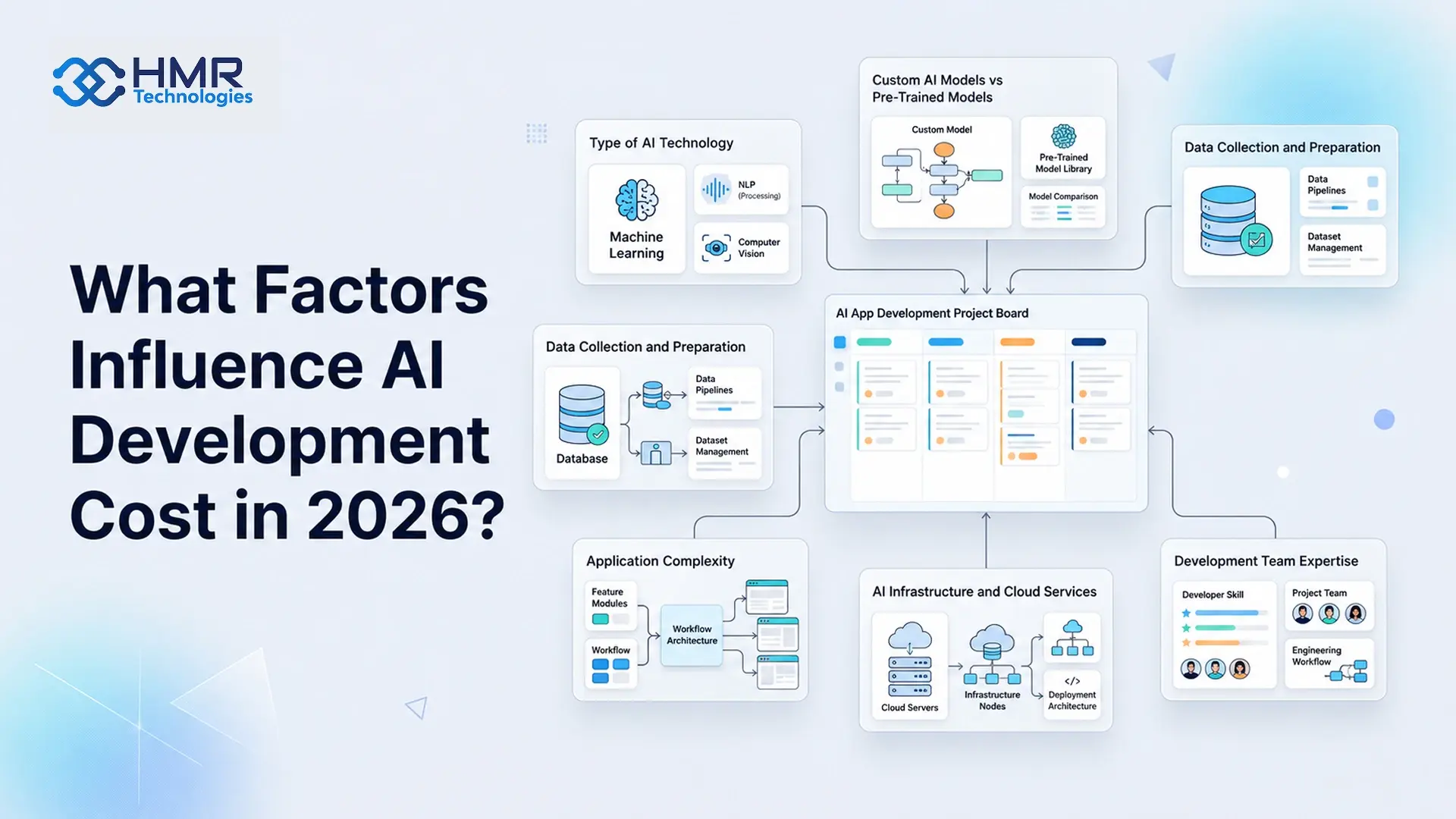
Type of AI Technology
The first factor that impacts development pricing is the type of AI technology used in the application. For example, a basic recommendation engine is much easier and less expensive to build than a generative AI assistant powered by large language models.
Traditional AI systems mainly focus on automation, prediction, and data analysis. Generative AI systems require advanced processing power, prompt engineering, vector databases, and large-scale AI infrastructure, which increases development complexity.
The more advanced the AI functionality, the higher the overall cost of AI development.
Custom AI Models vs Pre-Trained Models
Many businesses reduce development costs by using existing AI APIs and pre-trained models from providers such as OpenAI, Anthropic, or Google. This approach helps accelerate development while lowering infrastructure and training costs.
However, companies building industry-specific AI products often require custom-trained models. In such cases, developers must train AI systems using proprietary datasets, optimize model performance, and manage dedicated AI infrastructure.
Custom AI solutions offer better personalization and accuracy, but they also increase the cost of custom AI development significantly.
Data Collection and Preparation
AI systems rely heavily on quality data. Before development begins, businesses often need to clean, organize, label, and structure large datasets. This process can become expensive, especially for healthcare, finance, and enterprise AI applications.
In many AI projects, data preparation alone can consume a major portion of the development budget.
Companies that already have organized business data usually reduce AI implementation costs and development timelines considerably.
Application Complexity
The complexity of the application also plays a major role in pricing.
A lightweight AI MVP may only require:
- Basic frontend design
- One AI integration
- Simple user workflows
Meanwhile, enterprise AI platforms may involve:
- Multiple AI models
- Real-time analytics
- Advanced dashboards
- Cloud-native architecture
- Third-party software integrations
- High-level cybersecurity implementation
The more features, workflows, and integrations involved, the higher the development cost becomes.
AI Infrastructure and Cloud Services
AI applications require powerful infrastructure to process and analyze large amounts of data efficiently.
Cloud platforms such as AWS, Microsoft Azure, and Google Cloud are commonly used for hosting AI models, storing datasets, and running machine learning workloads. Infrastructure expenses may include:
- GPU servers
- AI model hosting
- Cloud storage
- API usage costs
- Monitoring systems
- Security tools
Generative AI applications usually require higher cloud spending due to intensive processing requirements.
This is one reason why generative AI development costs are often higher than those of traditional AI applications.
Development Team Expertise
The experience level and location of the development team significantly influence overall pricing. A complete AI project often involves AI engineers, backend developers, frontend developers, data scientists, DevOps specialists, QA engineers, and UI/UX designers.
Hiring experienced AI developers in the US, UK, or Western Europe is considerably more expensive compared to offshore development regions such as India or Eastern Europe.
For startups, outsourcing development to a company specializing in mobile app development for startups and AI solutions often provides a better balance between quality, scalability, and cost efficiency.
Generative AI vs Traditional AI: Cost Comparison
| Comparison Factor | Traditional AI | Generative AI |
|---|---|---|
| Development Cost | Lower development cost due to simpler models and workflows | Higher development cost because of the complex LLM architecture and infrastructure |
| Infrastructure Requirement | Standard cloud servers and moderate computing power | GPU-intensive infrastructure with high-performance computing requirements |
| Data Dependency | Works mainly with structured and historical datasets | Requires massive datasets, embeddings, and contextual data handling |
| Training Complexity | Easier and faster model training | Advanced model training, fine-tuning, and prompt engineering are required |
| API & Operational Cost | Lower ongoing operational expenses | Higher API usage and recurring AI processing costs |
| Development Timeline | Faster implementation and deployment | Longer development cycles due to testing and optimization |
| Scalability Cost | Easier and cheaper to scale | Scaling can become expensive with increasing AI usage |
| Common Use Cases | Fraud detection, predictive analytics, recommendation engines, automation | AI chatbots, AI copilots, content generation, AI search, virtual assistants |
| Maintenance Requirement | Moderate maintenance and updates | Continuous optimization, monitoring, and retraining are required |
Cost to Build AI by Region (In-House vs Offshore)
The development location has a direct impact on AI project pricing. Companies building in-house AI teams in the United States or Europe often face high recruitment and operational costs. Salaries for experienced AI engineers alone can consume a significant portion of the overall budget.
In-house development also requires investments in:
- Office infrastructure
- Employee benefits
- Software licenses
- AI hardware
- Long-term operational management
For startups and mid-sized businesses, this model may not always be financially practical during the early stages.
This is why many global companies now prefer offshore AI development.
Countries like India have become popular outsourcing destinations because they offer experienced AI developers at significantly lower development costs.
An offshore development model helps businesses:
- Reduce operational expenses
- Scale teams faster
- Access specialized AI expertise
- Speed up development timelines
At the same time, businesses can maintain development quality by partnering with experienced IT service providers that follow structured development processes and international coding standards.
Why Hire Artificial Intelligence Developers from HMR Technologies?
Choosing the right development partner is one of the most important decisions in any AI project.
At HMR Technologies, businesses get access to experienced AI developers, scalable development processes, and cost-effective engagement models designed for startups, enterprises, and growing digital businesses.
The company focuses on delivering custom AI solutions for Enterprises that align with real business goals instead of unnecessarily complex implementations.
Whether you need an AI-powered chatbot, recommendation engine, automation platform, or generative AI application, the team works closely with clients to build secure, scalable, and performance-focused solutions.
HMR Technologies also helps businesses reduce development overhead by offering flexible offshore development support without compromising project quality.
From product strategy and MVP development to deployment and post-launch optimization, the company provides end-to-end assistance throughout the AI development lifecycle.
This helps businesses accelerate development while maintaining better control over overall project costs.
Conclusion
The AI app development cost in 2026 depends on multiple business and technical factors, including application complexity, AI model selection, infrastructure requirements, and development location.
A basic AI MVP may cost less than $20,000, while advanced enterprise-grade AI platforms can require six-figure investments.
Businesses planning AI development should focus on:
- Defining clear project goals
- Prioritizing MVP development
- Choosing scalable infrastructure
- Evaluating long-term operational costs
- Working with experienced AI development teams
For many startups, beginning with a lean AI solution and scaling gradually is the smartest way to manage risk and optimize investment.
Partnering with an experienced technology company like HMR Technologies can also help businesses reduce development complexity, accelerate project delivery, and build scalable AI applications aligned with long-term business goals.
As AI adoption continues to grow globally, businesses that invest strategically in AI development today will be better positioned to improve efficiency, automate operations, and build more competitive digital products in the future.


 July 7, 2026
 10 min read
-for-enterprise-AI-integration.webp)