





Introduction
If you’ve spent any time researching modern web development, you’ve almost certainly come across Node.js. It’s one of those technologies that seems to come up in every conversation about building fast, scalable web applications and for good reason.
Developers love it for its speed and flexibility. Businesses choose it because it cuts development time and scales well under pressure. But if you’re just getting started, you might still be wondering what the actual use cases are, and whether it’s the right fit for your next project.
If you’re planning a modern web application, choosing the right technology stack is just as important as selecting the right Node.js development services partner.
This guide breaks it all down from how Node.js works under the hood to where it genuinely delivers value in real-world web development.
What Is Node.js Development?
Node.js is an open-source, cross-platform JavaScript runtime environment that allows developers to run JavaScript code on the server side completely outside of a web browser. Before it came along in 2009, JavaScript was strictly a frontend language. Node.js changed that entirely.
Built on Google Chrome’s V8 JavaScript engine, Node.js compiles JavaScript into machine code and executes it at high speed. What makes it distinctive isn’t just the language; it’s the architecture. Node.js uses an event-driven, non-blocking model that’s fundamentally different from how older server technologies work.
The adoption numbers reflect just how far it has come. According to the Stack Overflow Developer Survey 2024, which gathered responses from over 48,000 developers, Node.js ranked as the most commonly used web technology, cited by 40.8% of respondents. Today, it powers over 30 million websites globally and is used by companies like Netflix, LinkedIn, Uber, and PayPal.
Understanding what Node.js is used for inweb development is the first step toward making smarter technology decisions for your business or your next build.
Node.js in 2025: Key Statistics That Prove Its Dominance
Before diving into how Node.js works, it helps to understand just how widely adopted it has become. These numbers tell the real story.
- 30 million+ websites run on Node.js globally as of 2025.
- 40.8% of developers ranked Node.js as the most commonly used web technology in the Stack Overflow Developer Survey 2024.
- 64.2% of developers admire Node.js, and 31.8% said they want to start using it.
- 50–60% reduction in page load times is commonly reported by companies after switching to Node.js.
- PayPal saw a 35% decrease in average response time after migrating from Java to Node.js.
- Over 271,000 companies adopted Node.js in 2024 alone.
- Development costs reduced by 57%+ is a figure frequently cited by businesses that have moved their backend stack to Node.js.
Numbers like these don’t happen by accident. They reflect a technology that solves real problems—speed, scalability, and developer efficiency—in a way that resonates across both startups and Fortune 500 companies.
How Node.js Works in Web Development
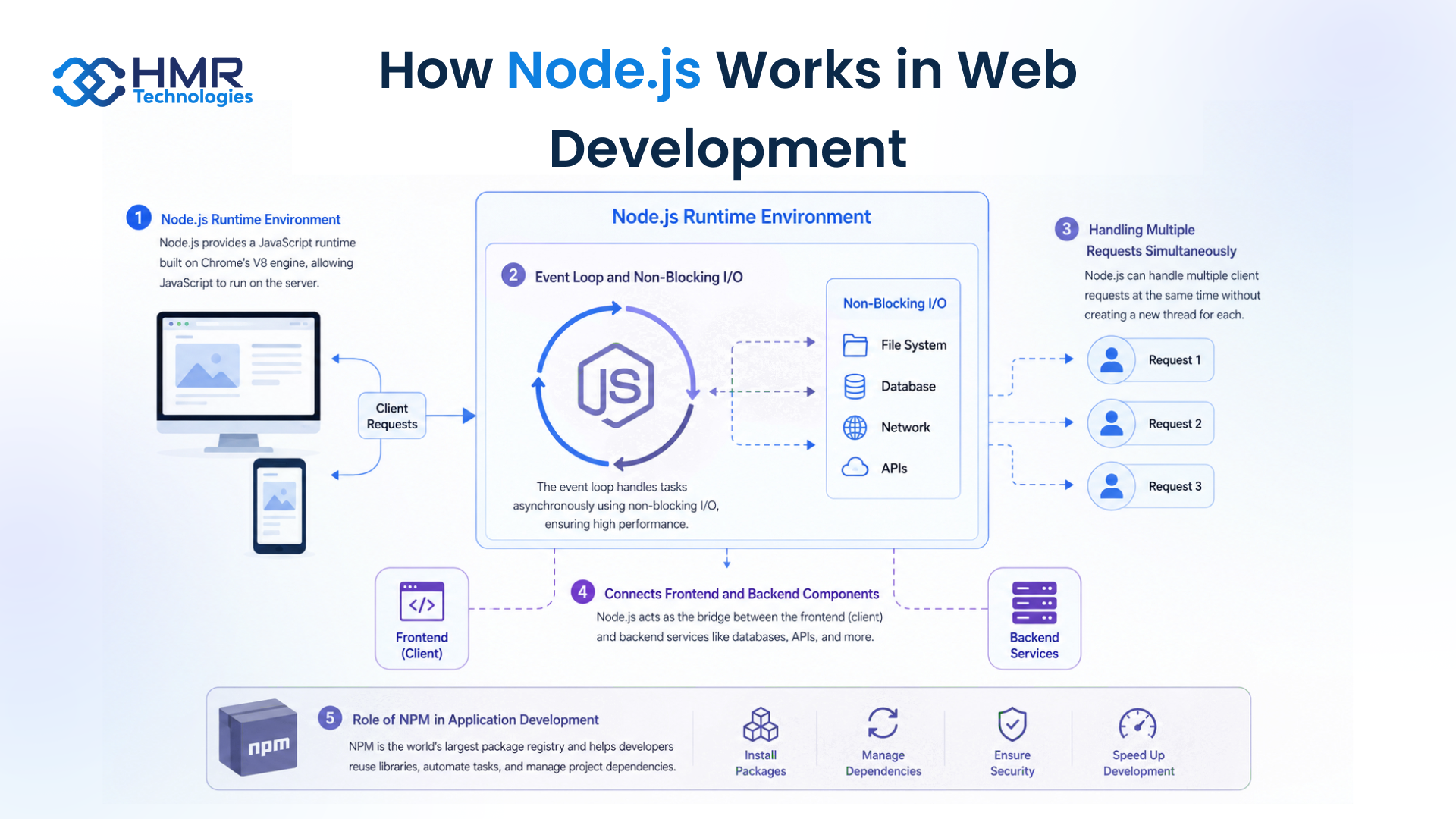
To appreciate why Node.js for web development makes sense, you need to understand what’s happening under the hood.
Node.js Runtime Environment
Node.js runs on the V8 JavaScript engine, the same engine that powers Google Chrome. V8 compiles JavaScript directly into machine code, which is one big reason why Node.js applications tend to run fast.
Unlike traditional server-side environments that create a new thread for every incoming request, Node.js operates on a single-threaded model. This might sound like a limitation at first, but the way it handles concurrent requests is actually one of its biggest strengths.
The Event Loop and Non-Blocking I/O
The heart of Node.js is its event loop, a mechanism that allows Node.js to perform non-blocking input/output operations.
When a request comes in that requires reading from a database or fetching data from an external API, Node.js doesn’t just sit there waiting. It registers the task, moves on to handle other requests, and comes back when the result is ready.
This is fundamentally different from the blocking model used in older server technologies. In a blocking model, the server waits for one task to complete before moving to the next. Node.js eliminates that bottleneck.
Handling Multiple Requests Simultaneously
Because of this non-blocking architecture, Node.js can handle thousands of concurrent connections without breaking a sweat.
It doesn’t need to spin up a new thread for each request, which significantly reduces memory consumption and improves overall throughput.
This makes it particularly well-suited for applications that deal with many simultaneous users or high-frequency data exchanges.
Frontend and Backend Components
One of the more underrated advantages of Node.js backend development is how naturally it bridges the gap between frontend and backend. Since both sides use JavaScript, developers can share code, libraries, and even data validation logic across the stack.
This kind of code reusability reduces development time and makes it easier to maintain consistency across a project.
Teams no longer need separate specialists for frontend and backend. A single full-stack JavaScript developer can work across the entire application.
Role of NPM in Application Development
Node.js comes bundled with NPM (Node Package Manager), the world’s largest software registry.
With over a million open-source packages available, developers rarely need to build common functionality from scratch.
Need authentication? There’s a package.
Need to handle file uploads, send emails, or connect to a database? There’s a package for that too.
NPM dramatically speeds up development while keeping codebases lean and manageable.
Why Is Node.js Popular for Enterprise Web Development?
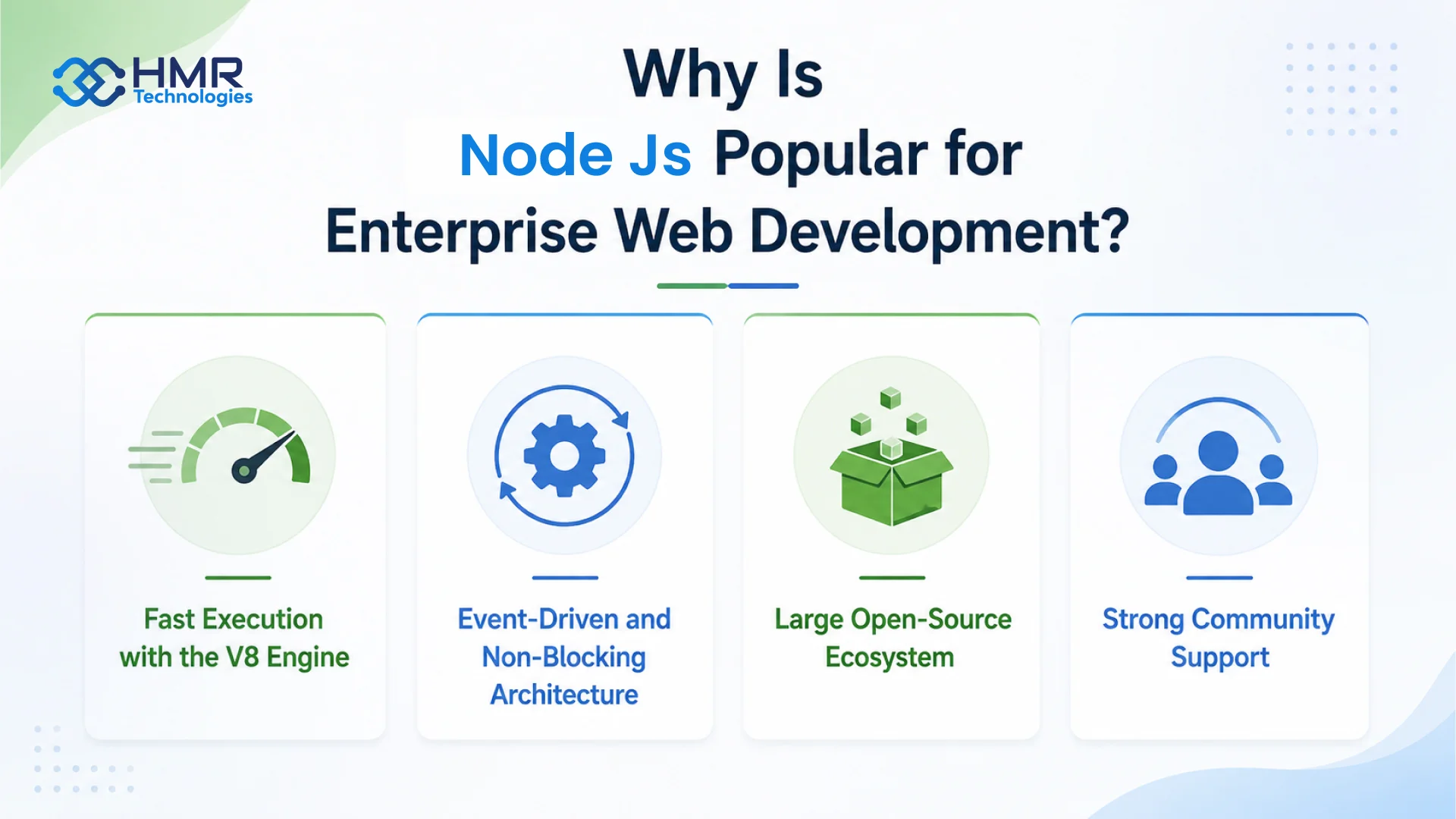
Node.js hasn’t just caught on with indie developers and startups—large enterprises are using it at scale.
Fast Execution with the V8 Engine
The V8 engine doesn’t just interpret JavaScript—it compiles it into optimized machine code at runtime.
The result is execution speeds that are genuinely competitive with more traditionally fast server-side languages like Java or C++.
Studies suggest Node.js can reduce web page loading times by 50–60%, which directly impacts user experience and conversion rates.
Event-Driven and Non-Blocking Architecture
The heart of Node.js is its event loop, a mechanism that allows Node.js to perform non-blocking input/output operations. When a request comes in that requires reading from a database or fetching data from an external API, Node.js doesn’t just sit there waiting. It registers the task, moves on to handle other requests, and comes back when the result is ready.
This is fundamentally different from the blocking model used in older server technologies. In a blocking model, the server waits for one task to complete before moving to the next. Node.js eliminates that bottleneck.
Frontend and Backend Development
Maintaining two separate tech stacks—one for the frontend and one for the backend—adds complexity and cost.
With Node.js, engineering teams can standardize on JavaScript across the board.
This simplifies hiring, code reviews, onboarding, and long-term maintenance.
For businesses working with custom software development partners, this also means faster project delivery.
Large Open-Source Ecosystem
The NPM ecosystem gives Node.js development teams a massive head start.
Rather than building every feature from scratch, developers can pull in well-tested, community-maintained packages.
This accelerates timelines and reduces the risk of introducing bugs through custom implementations.
Strong Community Support
Node.js has one of the most active developer communities in the world. In the Stack Overflow Developer Survey 2024, 64.2% of developers said they admire Node.js and 31.8% expressed a desire to start using it.
That kind of enthusiasm translates into well-documented libraries, frequent updates, quick bug fixes, and a large pool of experienced developers available for hire. For businesses planning long-term projects, community health is an important factor in technology selection.
Key Use Cases of Node.js in Web Development
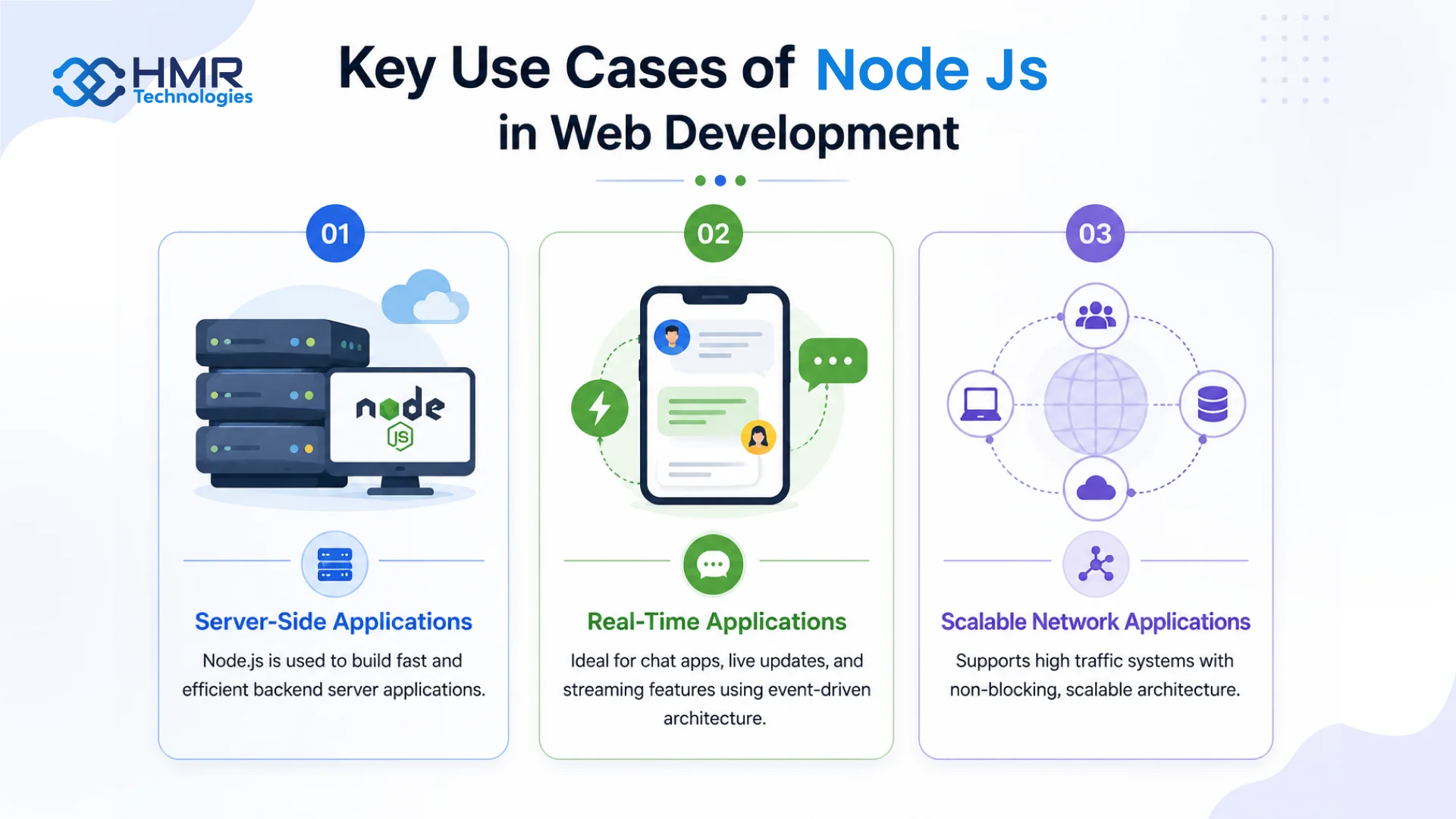
Knowing what Node.js can do is one thing; seeing where it actually gets used is another.
Server-Side Applications
Node.js excels as a server-side application framework. It handles RESTful APIs, microservices, and server-rendered web applications efficiently. Companies building modular, service-oriented architectures often find that Node.js fits naturally into that design pattern.
Its lightweight footprint also makes it ideal for containerized deployments and serverless environments. Teams working on Node.js development services often start here before layering in more complex functionality.
Real-Time Applications
This is arguably where Node.js truly shines.
Because of how the event loop handles concurrent connections, Node.js is purpose-built for applications that require real-time communication.
Examples include:
- Live chat systems
- Customer support tools
- Collaborative platforms
- Real-time dashboards
- Multiplayer gaming backends
- Push notification services
WebSocket support makes it straightforward to maintain persistent connections between server and client.
Scalable Network Applications
Whether you’re building a content delivery system, a high-traffic API gateway, or a data streaming pipeline, Node.js scales without the overhead associated with thread-based servers. This scalability is why companies building lean on Node.js; it lets early-stage products handle growth without requiring a full architectural overhaul. You can also explore the best frameworks for web development to understand how Node.js compares with other options in the ecosystem.
Why Businesses Choose Node.js Development Services
Beyond the technical merits, there are practical business reasons why companies keep choosing Node.js.
Development speed is real. Because of NPM, shared code between frontend and backend, and the large developer talent pool, projects built on Node.js tend to move faster from kickoff to launch. For businesses with tight timelines or competitive pressures, that matters.
Operational costs are lower. Running fewer servers to handle the same number of concurrent users reduces infrastructure spend. Node.js’s efficiency translates directly to cost savings at scale.
It integrates well with modern tooling. Whether you’re using cloud infrastructure from AWS, Azure, or Google Cloud, or building with containerization tools like Docker and Kubernetes, Node.js fits naturally into modern DevOps workflows. Teams building custom AI solutions for enterprises also benefit from Node.js’s compatibility with machine learning libraries and data pipelines.
Hiring is easier. JavaScript is the most widely known programming language in the world. Finding experienced Node.js developers is simpler than recruiting for more niche server-side languages. And for companies that need to build a dedicated development team, having a single-language stack means onboarding is faster and collaboration between team members is smoother from day one.
For enterprises specifically, the combination of performance, ecosystem maturity, and developer availability makes Node.js a dependable foundation for long-term projects. You can also learn how AI enterprise software development trends are intersecting with Node.js-based architectures in modern enterprise tech stacks.
Conclusion
Node.js has earned its place as one of the most versatile and dependable technologies in modern web development.
Its non-blocking architecture, the speed of the V8 engine, the richness of the NPM ecosystem, and the advantage of using a single language across the full stack make it a compelling choice for a wide range of applications.
Whether you’re building a real-time chat platform, a scalable API backend, or an enterprise-grade web application, Node.js for web development offers the performance and flexibility to get it done right.
If your business is evaluating technology options for an upcoming project, it’s worth having a conversation with an experienced Node.js development team who can help you assess whether it’s the right fit for your specific requirements.



 July 23, 2026
 10 min read