



Every successful SaaS product founder starts with the same question.
What should we build?
For startup founders, the answer goes far beyond choosing a product idea. It shapes the business model, development roadmap, investment requirements, and long-term growth strategy.
Making that decision in 2026 has become more challenging than ever.
Artificial intelligence is speeding up software development. Cloud infrastructure has reduced launch costs. No-code and low-code platforms are making SaaS product development services more accessible, enabling startups to validate ideas faster and launch products with greater confidence.
Meanwhile, competition in the SaaS industry has increased. The hardest part is not building software but building software to solve the right problem.
That’s why many founders are moving away from creating broad, feature-rich platforms. Instead, they’re developing point solutions that address one specific problem for one well-defined audience.
This change has brought Micro SaaS into the limelight.
Which model should your startup follow then?
In this guide, we’ll compare Micro SaaS vs Traditional SaaS, explore their key differences, and evaluate development costs, scalability, resource requirements, and revenue potential to help you choose the right SaaS model for your startup in 2026.
What Is Micro SaaS?
Not every successful SaaS business needs a large team, millions in funding, or an extensive feature set.
Many of the fastest-growing software businesses are built around a much simpler idea to solve one specific problem exceptionally well for a clearly defined audience. That’s the core principle behind Micro SaaS.
A Micro SaaS is a small-scale software business designed to address a niche market or a specific business challenge. Unlike traditional SaaS platforms that often serve multiple industries and offer dozens of features, Micro SaaS products focus on delivering a single solution that customers genuinely need.
For example, instead of building an all-in-one CRM, a Micro SaaS product might automate appointment reminders for dental clinics or generate invoices exclusively for freelance designers. By narrowing its focus, the product becomes easier to build, market, and maintain.
The growing adoption of AI development tools, APIs, and cloud platforms has further accelerated the rise of Micro SaaS.
That doesn’t mean building a Micro SaaS is easy.
Founders can now build, test, and launch products in a fraction of the time compared to just a few years ago, making it easier to validate ideas before investing heavily in expansion.
As products evolve, founders also need to reduce software product development complexity to keep development efficient, control costs, and scale without unnecessary technical overhead.
What Is Traditional SaaS?
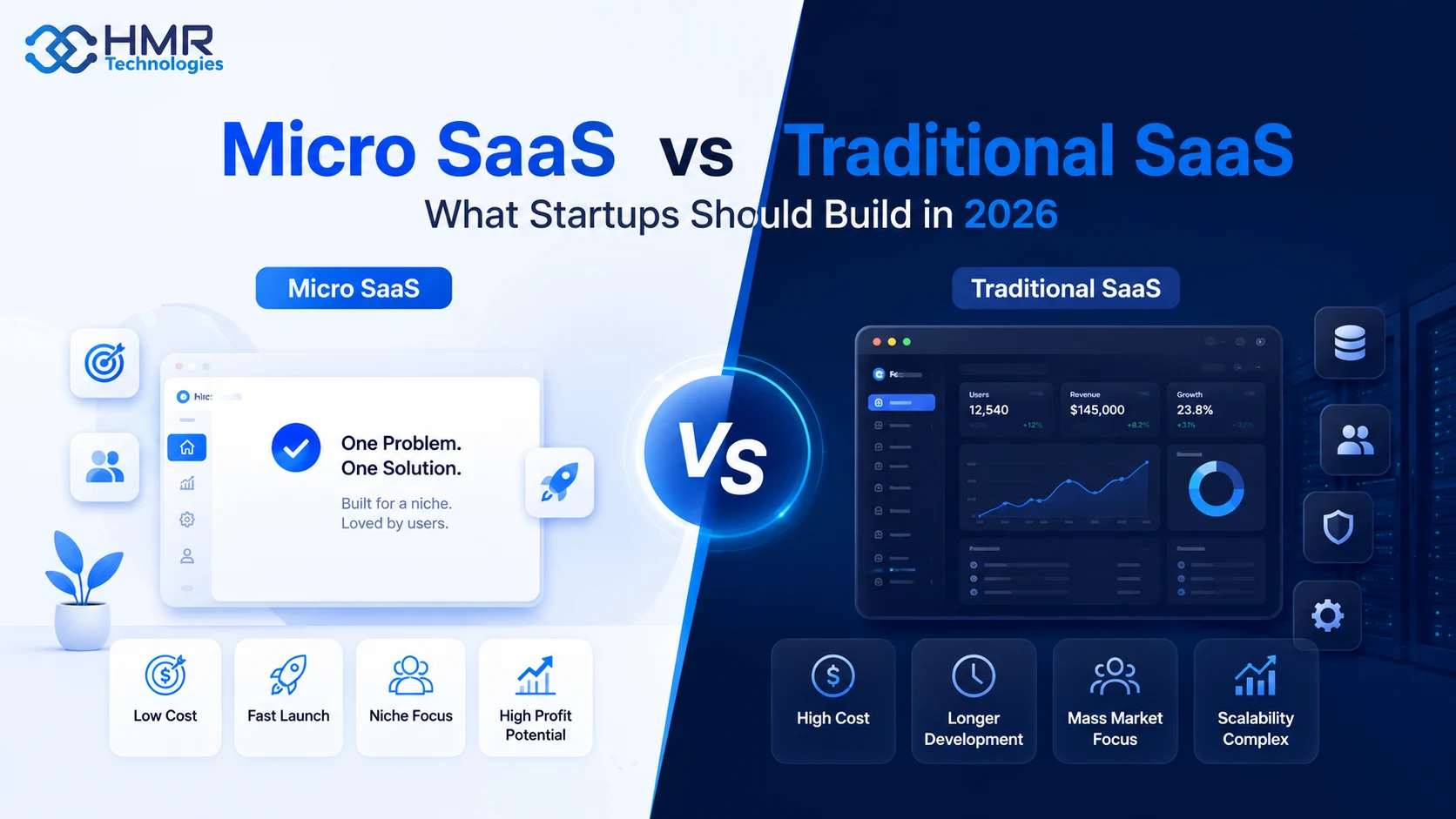
Micro SaaS is designed to solve one specific problem, while Traditional SaaS is built to cater to a wider market with a comprehensive set of features.
A traditional SaaS product is a cloud-based software platform for businesses of all sizes, often supporting multiple departments, complex workflows, and thousands of users. This category includes popular solutions such as CRM, ERP, HRMS, and project management platforms.
Building a traditional SaaS product generally requires a larger development team, more capital, and a longer time to market. Businesses often combine it with broader custom software development services as a strategy to support unique workflows, enterprise integrations, and long-term scalability.
Key Characteristics of Traditional SaaS
- Serves a broad customer base across multiple industries.
- Offers comprehensive features and integrations.
- Requires larger development teams and higher investment.
- Longer development and product launch timeline.
- Designed for long-term scalability and enterprise growth.
- Higher revenue potential with the ability to support thousands of customers.
For startups aiming to build an enterprise-grade platform or compete in larger markets, Traditional SaaS provides the foundation for sustainable, long-term growth despite its higher initial investment.
Many modern SaaS platforms also implement AI in business workflows to automate repetitive tasks, improve decision-making, and deliver more personalized user experiences.
Key Differences Between Micro SaaS and Traditional SaaS
Both Micro SaaS and Traditional SaaS follow the same subscription-based business model, but they differ significantly in terms of product scope, investment, scalability, and growth strategy. Understanding these differences helps founders choose a model that aligns with their budget, target market, and long-term business goals.
| Factor | Micro SaaS | Traditional SaaS |
|---|---|---|
| Team Size | Usually 1–5 people, often solo founders or small teams. | Typically 10–100+ professionals, including developers, designers, marketers, sales, and support teams. |
| Initial Investment | Low investment, making it ideal for bootstrapped startups. | Requires significant capital for product development, infrastructure, and team expansion. |
| Development Time | Usually 2–6 months to launch an MVP or first version. | Generally 9–18 months or longer, depending on product complexity. |
| Scalability | Designed to serve a niche audience with gradual growth. | Built to support thousands of users, multiple markets, and enterprise-scale operations. |
| Revenue Potential | Moderate but predictable recurring revenue from a focused customer base. | Higher revenue potential through larger markets, enterprise clients, and multiple pricing tiers. |
| Maintenance | Easier to manage due to fewer features and a simpler codebase. | Requires continuous updates, security improvements, infrastructure management, and dedicated support teams. |
| Target Audience | Niche businesses or a specific group of users with a well-defined problem. | SMBs, mid-sized companies, and large enterprises across multiple industries. |
Choosing between Micro SaaS vs Traditional SaaS isn’t about deciding which model is better it’s about selecting the one that best matches your startup’s vision, available resources, and growth ambitions. Founders looking for faster validation and lower risk often prefer Micro SaaS, while businesses targeting large-scale markets typically invest in building a Traditional SaaS platform.
Why More Startups Are Choosing Micro SaaS in 2026
The startup landscape has evolved rapidly in recent years. AI-powered development, cloud infrastructure, and modern SaaS tools have made it easier for founders to build and launch software with smaller teams and lower upfront investment. As a result, many entrepreneurs are choosing Micro SaaS over traditional software models.
One of the biggest advantages of a Micro SaaS business is its faster time to market. By focusing on a single problem for a niche audience, founders can launch an MVP development project quickly, gather real user feedback, and refine the product before investing in large-scale development.
Lower costs are another key factor. Unlike traditional SaaS platforms that require larger teams and significant funding, Micro SaaS products can often be built and managed by just a few people. This makes bootstrapping a practical option for many startups.
Customer demand is also shifting toward specialized software. Businesses increasingly prefer simple solutions that address their specific needs rather than paying for feature-heavy platforms they rarely use.
For startups in 2026, Micro SaaS offers a practical path to building profitable software. It enables founders to validate ideas faster, reduce financial risk, and grow sustainably while serving a well-defined market.
Micro SaaS vs Traditional SaaS: Development Cost, Team Size, and Time to Market
Choosing between Micro SaaS and Traditional SaaS isn’t just about the type of product you want to build. It also affects your budget, hiring plans, development timeline, and long-term operational costs. Understanding these factors can help startups make a more informed decision before investing in product development.
Development Cost
A Micro SaaS product is generally more affordable to build because it focuses on solving a single problem with a limited feature set. Most projects can be developed with a smaller budget, making them ideal for bootstrapped startups. In contrast, Traditional SaaS platforms require significantly higher investment due to complex features, integrations, and enterprise-level infrastructure.
Team Size
Most Micro SaaS businesses are built by a solo founder or a small team of developers and designers. Traditional SaaS products, however, require larger cross-functional teams that include engineers, QA specialists, UI/UX designers, marketers, sales professionals, and customer support teams. To meet changing project demands without increasing permanent hiring costs, many startups rely on IT staff augmentation to quickly access specialized development talent.
Time to Launch
Since the product scope is smaller, a Micro SaaS solution can often be launched within a few months. A Traditional SaaS platform usually takes much longer because of extensive development, testing, integrations, and scalability planning.
Monthly Operating Costs
Operating a Micro SaaS business typically involves lower expenses for hosting, maintenance, and customer support. Traditional SaaS platforms have higher recurring costs as they require scalable cloud infrastructure, security monitoring, continuous feature updates, and dedicated support teams.
Marketing Budget
Marketing a Micro SaaS product is usually more targeted because it serves a niche audience. This allows startups to acquire customers with relatively smaller marketing budgets. Traditional SaaS products compete in broader markets, requiring larger investments in branding, paid advertising, content marketing, and sales activities.
For founders with limited resources, Micro SaaS offers a faster and more cost-effective route to market. However, startups aiming to build enterprise-grade software with significant long-term growth potential may find the Traditional SaaS model better aligned with their business objectives.
Why Choose HMR Technologies for SaaS Product Development?
The success of a SaaS product depends on more than the technology behind it. It starts with understanding the market, defining the right product strategy, and building a platform that can evolve as customer needs change.
At HMR Technologies, we partner with startups and businesses to develop SaaS products that balance performance, scalability, and long-term maintainability. Every project begins with understanding your business objectives, target audience, and growth plans before a single line of code is written.
Whether you’re launching a Micro SaaS product to validate a niche idea or developing a scalable B2B SaaS platform, our team follows a structured development approach that minimizes risk and accelerates time to market. From product discovery and UI/UX design to cloud deployment and ongoing product enhancements, we support every stage of the development lifecycle.
Our expertise spans web development services, cloud-native architecture, API integrations, and scalable application development, helping businesses build reliable SaaS platforms that are ready to scale. This enables us to build secure, reliable, and high-performing SaaS solutions that are designed to grow alongside your business.
By combining technical expertise with a product-first mindset, HMR Technologies helps founders transform ideas into market-ready SaaS products that deliver long-term business value.
Conclusion
There isn’t a one-size-fits-all answer in the Micro SaaS vs Traditional SaaS debate. The right choice depends on what you’re trying to achieve, the resources you have, and the market you want to serve.
If you’re looking to validate an idea quickly, operate with a lean team, and build a profitable business around a niche audience, Micro SaaS offers a practical and cost-effective path. On the other hand, if your vision involves serving enterprise customers, supporting complex workflows, and scaling across multiple industries, Traditional SaaS provides the flexibility and growth potential to achieve those goals.
Before investing in development, take the time to evaluate your target audience, budget, product roadmap, and long-term business objectives. Choosing the right SaaS model from the beginning can reduce development risks, improve resource allocation, and increase your chances of building a successful product.
Whether you’re planning to launch a focused Micro SaaS business or a scalable B2B SaaS platform, partnering with an experienced development team can make the journey smoother. At HMR Technologies, we help startups and enterprises transform innovative ideas into secure, scalable, and market-ready SaaS products that are built for sustainable growth.


 July 18, 2026
 10 min read